
How Personal Trainers Can Build a Premium Brand Online Without Showing Their Face
By Elite Media Mechanics | Digital Marketing & PR Agency | UK · US · India
“In 2026, your ideas enter the room before your identity ever does. That’s not a limitation. That’s a strategy.”
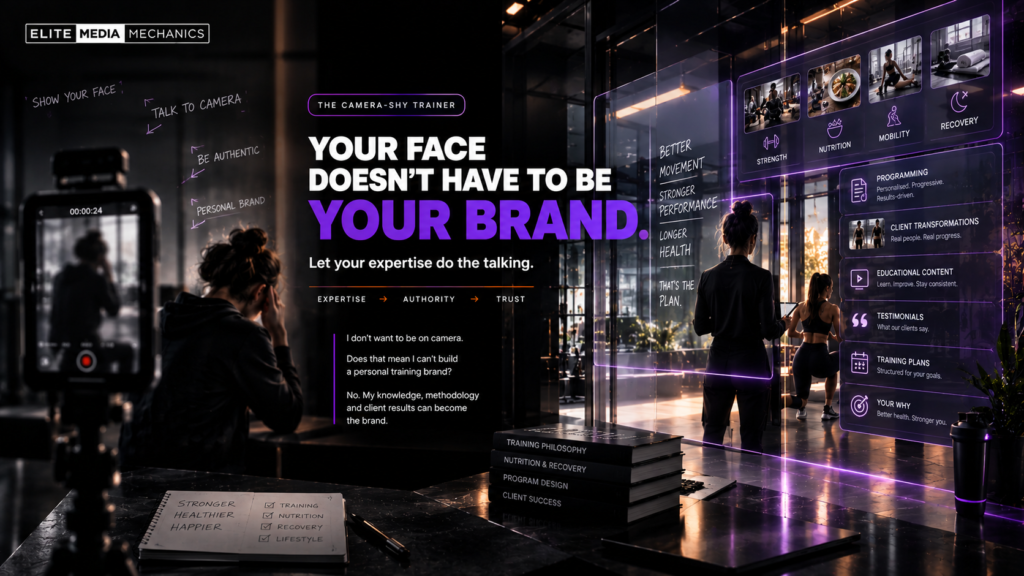
The Camera-Shy Trainer’s Dilemma
You’re an exceptional personal trainer. Your clients see real transformation. Your knowledge of strength training, mobility, nutrition, and recovery is genuinely elite. You understand periodisation, progressive overload, and the psychological side of behaviour change at a level most coaches never reach.
But every piece of marketing advice you’ve ever received says the same thing: “Show your face. Be authentic. Build a personal brand around YOU.”
What if you’re camera-shy? What if you simply don’t want your face plastered across the internet indefinitely? What if you’d rather your expertise be the brand, not your appearance? What if the idea of filming yourself talking to a phone camera makes you uncomfortable in a way that no amount of motivation can override?
Here’s the good news nobody in the fitness industry is telling you: in 2026, you don’t need to show your face to build a premium, profitable personal training brand. In fact, for many trainers, choosing not to show their face has become the smarter strategic move — not the fallback position.
This Isn’t a Niche Trend Anymore — It’s a Movement
Let’s start with the numbers, because they tell a story most trainers haven’t caught up to yet.
Faceless content has exploded from a fringe tactic into mainstream strategy. The hashtag associated with faceless marketing has grown to over 5.8 million reels on Instagram alone. Faceless accounts now represent 38% of all new creator monetisation ventures — a 217% increase since 2022.
And it’s not just hobbyists or passive income creators. According to recent marketing industry data, 68% of marketers are now actively choosing faceless strategies to save time, protect privacy, and scale content production without the burnout that comes from constant on-camera performance.
Faceless content also costs roughly 58% less to produce than face-to-camera formats, while taking a fraction of the time to create. For a solo personal trainer juggling 10–15 client sessions per week, programming, admin, and client communication — that efficiency isn’t a nice bonus. It’s the difference between having a consistent content strategy at all, or abandoning it after three weeks because it was unsustainable.
Why This Works Especially Well for Personal Trainers
1. Your Authority Comes From Results, Not Looks
Clients don’t hire a trainer because of how they look on Instagram. They hire a trainer because they trust the method. They believe in the approach, the philosophy, and the outcomes it produces. A 2025 audience sentiment study found that 72% of younger viewers care more about content quality than whether they can see the creator’s face.
When you remove your face from the content, something important happens: the audience’s attention shifts entirely to the value you’re providing — the technique breakdown, the myth you’re busting, the programming insight they’ve never heard explained that way before. Your knowledge becomes impossible to ignore, because there’s nothing else competing for attention.
This is particularly powerful in the fitness space, where face-led content has become so saturated that audiences have developed a reflexive scepticism toward it. When everyone looks and sounds the same — speaking to the same camera angles, using the same motivational language — content that leads with pure expertise and insight stands out simply by being different.
2. It Removes the Single Point of Failure
Personal training is already a deeply personal, energy-intensive profession. Adding “always be camera-ready, always be performing a personality for a phone camera, always be visually presentable” on top of 12-hour client days is a fast track to creative burnout.
Faceless brands don’t depend on a trainer’s mood, physical appearance, or daily availability to keep producing content. You can batch-produce a month of content in a single afternoon using text overlays, screen recordings, voiceovers, and designed carousels. If you’re tired, unwell, or simply don’t feel like being “on” — your content engine keeps running. This is why so many faceless creators report far lower burnout rates than personality-led creators who are chasing constant on-camera output.
3. It Protects Your Privacy While Building a Transferable Asset
Many trainers — particularly those building local, premium-positioned brands in the UK, US, and India — don’t want their personal identity, lifestyle, and face permanently attached to a public professional presence. Faceless branding lets your expertise become the asset, rather than your personal identity.
This also has a practical long-term benefit: a faceless brand is transferable in a way that a face-led personal brand never is. If you eventually want to build a team, launch a digital product, or evolve your business model — your brand isn’t trapped in your personal identity. It can grow with you without being constrained by you.
The Honest Caveat: What Faceless Branding Doesn’t Mean
Before we go further, it’s worth being direct about something, because this strategy is only effective when it’s understood correctly.
Faceless doesn’t mean personality-less.
Some industry researchers, including data from Hootsuite’s 2026 social trends report, note that audiences generally trust people more than faceless entities — and that personal connection still matters significantly in fitness, where trust and accountability are core to the client relationship.
This isn’t a contradiction of the faceless approach. It’s a clarification of what it requires. A faceless brand still needs a recognisable voice. A consistent point of view. A defined aesthetic. A tone that feels human and knowledgeable and trustworthy — delivered through words, design, and strategic content rather than through a camera lens.
Done correctly, a faceless personal training brand feels deeply personal. The audience knows how you think, what you believe, and why your approach is different — they just don’t know what you look like. And in many cases, that makes the expertise feel more credible, not less, because it hasn’t been filtered through the vanity and performance that characterise so much fitness content.
The Faceless Trainer Content Framework: 5 Step
Step 1: Build Your Diagnostic Voice First
The most powerful faceless content in the fitness space isn’t motivational. It’s diagnostic. It identifies problems, dismantles myths, and presents frameworks.
Instead of showing yourself doing an exercise, diagnose a problem. “Why your knees cave on squats — and it’s not your glutes.” “The reason your clients stop seeing results at week 8 — and how to fix it.” “3 things your current nutrition plan is missing, regardless of who wrote it.”
This positions you as the expert who sees what others miss — without ever needing to appear on screen. And crucially, it creates content that people save and share — the highest-value engagement signal on every platform in 2026.
Step 2: Develop a Recognisable Visual System
Without a face as the visual anchor, your brand identity needs to do even more work. This means: a consistent colour palette, a consistent typography style, a consistent layout structure for your carousels, and a consistent aesthetic for any footage you use (workout clips, environment shots, or stock that matches your brand).
The strongest faceless brands are instantly recognisable from the thumbnail alone — before anyone reads a word of the caption. Your visual system is what creates that recognition. It doesn’t have to be elaborate. It has to be consistent.
Step 3: Use Text and Motion as Your Primary Creative Tools
Faceless content relies primarily on text overlays, motion typography, voiceovers, and designed graphics. In the fitness context, this translates to: text-based reels with a strong opening hook, diagnostic carousel posts that walk through a problem and its solution slide by slide, bold typographic static posts with a single powerful statement, and short voiceover reels where your knowledge is the audio.
What this content lacks in visual personality, it compensates for in directness. Every second of a text-based reel is delivering information — there’s no setup, no small talk, no visual filler. Audiences that value substance over performance respond very strongly to this approach.
Step 4: Create a Repeatable Content System
The brands that win with faceless content — in fitness and every other niche — are the ones that have identified 3–5 content formats and repeat them consistently rather than inventing something new every time.
For a personal trainer, that might look like: a weekly “myth busted” reel, a bi-weekly diagnostic carousel, a monthly “training principle explained” static post, and regular question-answer stories using text only. Each format is recognisable. Each builds on the others. Together, they create a content identity that audiences start to expect — and look forward to.
Step 5: Let Expertise Be the Personality
Your tone of voice — direct, premium, no-nonsense, deeply knowledgeable — is your personality. Faceless brands don’t sell charisma. They sell clarity, authority, and outcomes.
This means every piece of content needs a clear point of view. Not “here’s how to do a deadlift.” But “here’s why most deadlift instructions are wrong, and what actually matters.” Not “nutrition is important.” But “here’s the specific nutritional mistake I see in 9 out of 10 clients who aren’t progressing.”
Specificity, confidence, and genuine expertise are the three personality traits that a faceless brand runs on. If your content has those three things, your audience will trust you. They’ll share your content. They’ll DM you. And they’ll eventually hire you — without ever seeing your face.
Content Types That Work Without Showing Your Face
Here’s a practical breakdown of the specific formats that perform well for faceless fitness brands:
Text-based Reels: A strong opening line, key information delivered through on-screen text, trending or original audio underneath. These require no camera, no lighting, no personal appearance. The hook does all the work.
Diagnostic Carousels: Slide 1 identifies a problem your audience has. Slides 2–4 explain the cause. Slide 5 presents the solution. Slide 6 contains the CTA. This format generates saves and shares consistently — the highest-value engagement signals on Instagram.
Voiceover Reels: Screen recordings, footage of exercises (not your own — stock or client footage with permission), or simple graphic animations with your voiceover explaining a concept. Your voice is your brand. Your face is optional.
Bold Statement Posts: A single sentence. Strong typography. A clear point of view. These perform as standalone posts and generate conversation in the comments — which the algorithm rewards heavily.
Before/After Frameworks: Not client photos (which raise privacy issues) but before/after thinking — “Most trainers approach X this way. Here’s why that’s wrong. Here’s what actually works.” This is faceless content that positions you as the expert who sees differently.
The Bigger Picture for 2026
The fitness industry is shifting away from chasing aesthetics and toward valuing genuine expertise, longevity, and trust. At the exact same moment, content consumption habits are shifting away from celebrity-style personal branding and toward value-first, identity-optional content.
These two shifts align perfectly for a certain kind of trainer: the one who would rather let their knowledge speak than their face. 2026 isn’t punishing that approach — it’s rewarding it with better engagement rates, lower burnout, and a more sustainable content operation.
“Stop selling your identity. Start selling your value.”
That single shift in mindset is what separates a trainer with a few hundred followers from one building a premium, scalable brand that clients seek out — without ever needing to post a single selfie.
Frequently Asked Questions
Can a personal trainer really build trust without showing their face? Yes — and in some respects, more effectively. Trust in the fitness context comes from expertise, consistency, and demonstrated results — not from appearance. Content that consistently delivers insight people can’t find elsewhere builds the same depth of trust as a face-led brand, often more durably, because it’s anchored in knowledge rather than personality.
What if clients want to know what I look like before hiring me? This is a legitimate question, and the answer is: some will, and those may not be your ideal clients. A faceless brand self-selects for clients who prioritise expertise over aesthetics — and those clients tend to be more committed, more results-focused, and more loyal. If you eventually want to reveal your identity, you can. But you’re under no obligation to start there.
Does a faceless brand work on all platforms, or just Instagram? It works across Instagram, YouTube, TikTok, LinkedIn, and even podcasting. Each platform has its own preferred format, but the core principle — leading with expertise rather than identity — translates across all of them.
How long does it take to build a following with a faceless brand? Timeline depends on content quality and consistency, but faceless brands typically build audiences more slowly than viral face-led content — and more durably. The followers a faceless brand attracts are there for the value, not the personality, which means lower churn and higher conversion to paid clients.
What equipment do I need to create faceless fitness content? Remarkably little. A design tool (Canva works perfectly), a phone for voiceovers if you’re using them, and stock footage or exercise clips if you want visual backgrounds. The minimal production requirement is one of the key advantages of this approach.
Is it possible to build a premium, high-ticket personal training brand without a face? Absolutely. In fact, faceless positioning often commands higher perceived authority in premium markets, because the brand communicates confidence without neediness. “I don’t need to show you who I am — my knowledge speaks for itself” is a powerful implicit positioning statement.
How Elite Media Mechanics Builds Faceless Fitness Brands
This is exactly the strategy behind our Mechanic Lens and Industry Autopsies content concepts — cinematic, diagnostic, premium content built entirely around insight and authority, with zero reliance on faces or office shots.
We help personal trainers across the UK, US, and India build content systems that position them as the expert their market searches for — using diagnostic carousels, cinematic text reels, and a content voice that feels global, premium, and unmistakably theirs.
Pause the problem. Play the solution.
Ready to Build a Brand That Doesn’t Need Your Face to Succeed?
- Elite Media Mechanics is a full-service Digital Marketing & PR agency working with fitness, hospitality, and lifestyle brands across the UK, US, and India. We don’t do generic. We fix brands.
Keywords: faceless personal brand, personal trainer marketing 2026, faceless content strategy, anonymous brand building, gym social media strategy, content without showing face, premium fitness branding, Elite Media Mechanics, fitness marketing UK US India
© 2026 Elite Media Mechanics. All rights reserved.