
By Elite Media Mechanics | Digital Marketing & PR Agency | UK · US · India
“You’re not doing it wrong because you’re lazy. You’re doing it wrong because nobody gave you the right system.”
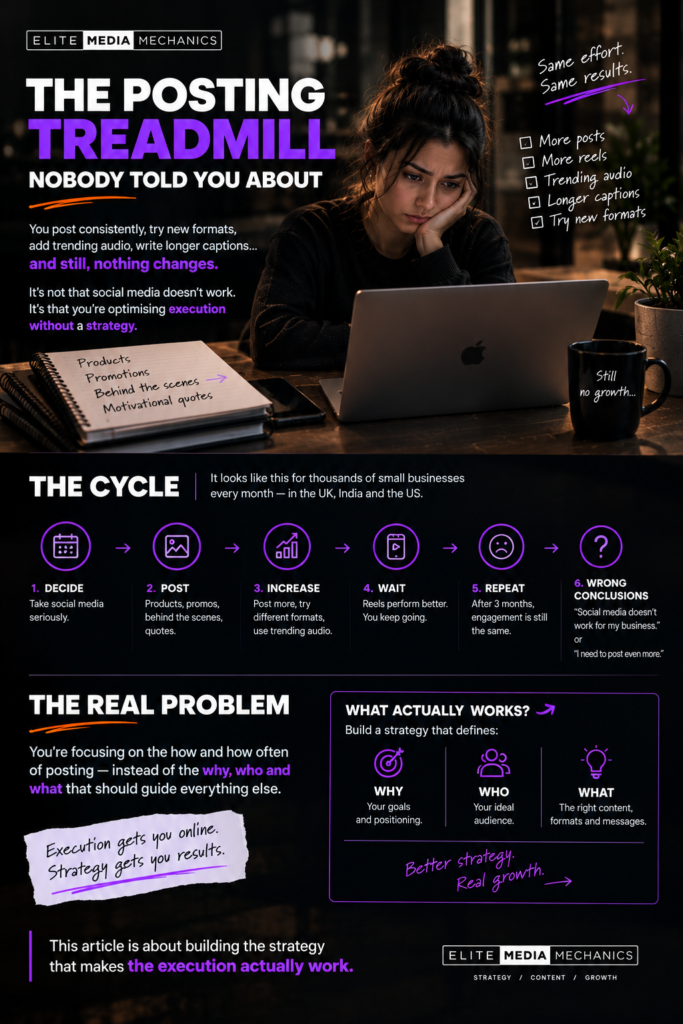
The Posting Treadmill Nobody Told You About
There’s a pattern that plays out in thousands of small businesses every month across the UK, India, and the US.
The owner decides to “take social media seriously.” They start posting consistently — products, promotions, behind-the-scenes moments, motivational quotes. They post three times a week for a month. Then four times. They try different formats. They watch reels perform better than static posts. They add trending audio. They write longer captions.
And after three months of genuine effort and consistent output, their engagement is essentially the same as when they started. The follower count has barely moved. The comments are mostly from existing followers and a few bots. The saves are negligible. The DM enquiries they hoped for haven’t materialised.
At this point, most business owners draw one of two conclusions: either “social media doesn’t work for my kind of business,” or “I need to post even more.” Both conclusions are wrong. The real issue is that they’ve been optimising execution — the how and how often of posting — without ever addressing the strategy — the why, the who, and the what that should determine everything else.
This article is about building the strategy that makes the execution actually work.
Why Content Fails Before It’s Even Posted
The majority of business content underperforms not because of production quality or posting frequency. It underperforms because of strategic gaps that are invisible at the point of creation but fatal at the point of distribution.
Gap 1: No defined audience “Our audience is anyone who could use our service” is the content strategy equivalent of having no content strategy. When you’re trying to speak to everyone, you resonate with no one. The personal trainer whose content is designed for “anyone who wants to get fit” will always underperform the one whose content is designed for “women over 35 who want to build functional strength without injury.” The more specific the audience, the more powerfully the content speaks to that audience — and the more that audience shares it with others exactly like them.
Gap 2: No clear content purpose Every piece of content should serve one of four strategic purposes: to be discovered (reach new audiences), to build trust (demonstrate expertise and authority to existing followers), to convert (move someone from follower to enquirer or customer), or to retain (keep existing customers engaged and loyal). Most businesses default to a vague mix that achieves none of these purposes effectively because the content wasn’t designed with any specific purpose in mind.
Gap 3: No reason to engage Content that generates no engagement often doesn’t have a built-in reason to engage. It doesn’t ask a question. It doesn’t make a surprising claim. It doesn’t offer information specific enough to be saved. It doesn’t trigger the reaction “I need to send this to someone.” Engagement isn’t a by-product of good content — it’s designed into good content at the concept stage.
Gap 4: No content identity Accounts with consistent growth have a content identity — a recognisable style, format, and voice that makes each post instantly recognisable as belonging to that account. Accounts with stagnant growth often have a content archive that looks like it was posted by several different people with no shared aesthetic or strategic intent. Identity creates recognition. Recognition creates loyalty. Loyalty creates engagement.
What the Data Says About Content That Actually Works
Understanding what the platform rewards — based on actual 2026 data — is the foundation of building a strategy that works.
According to Sprout Social’s Q1 2026 Pulse Survey, 40% of social media users say educational content is the number one type of content they want from brands. Not promotions. Not behind-the-scenes. Not aesthetics. Education — content that gives them something they can use.
The same research found that 66% of social media users are now more selective about what they engage with than they were a year ago. Audiences have developed a finely tuned filter for content that isn’t worth their attention, and they apply that filter within the first second of encountering a post. The standard for earning engagement has risen significantly, while the volume of content competing for attention has also risen. The only path through this filter is specificity, depth, and genuine value.
Metricool’s June 2026 analysis of over 24 million Instagram posts found that carousels now achieve 0.72% engagement rates, up 30.9% from 2025 — making them consistently the highest-engagement format for educational and informational content. DM shares — the signal that carries the most algorithmic weight — are most commonly triggered by content that feels so specifically useful or relevant that the viewer immediately thinks of someone else who needs to see it.
Reels remain the highest-reach format, with distribution to non-followers at a rate more than eight times higher than static posts. But the Reels that drive growth in 2026 are not the ones with the most production value — they’re the ones with the strongest hook in the first half-second and the clearest, most specific value delivered in the next fifteen seconds.
The Mechanic Lens: A Content Framework That Compounds
At Elite Media Mechanics, we use three core content concepts across our own channels and our client work. We call the underlying approach the Mechanic Lens — because it positions the brand as the expert who diagnoses problems that others miss, rather than the brand that simply promotes what it sells.
The framework has three components:
Component 1: Diagnostic Content Content built around identifying and naming a specific problem that your ideal customer either has or risks having — and explaining it with enough precision that they recognise themselves in it.
A gym: “The reason most people plateau at the gym after 3 months has nothing to do with their workout programme. It’s this.”
A hotel: “Why travellers regret booking the cheapest option — and what to look for instead.”
A café: “The thing most cafés get wrong that makes working there impossible after 11 AM.”
Diagnostic content works because it demonstrates expertise through observation — the brand isn’t selling anything, it’s noticing something. That noticing is what builds the authority that eventually makes selling much easier.
Component 2: Framework Content Content that provides a structured, repeatable system for achieving a specific result — turning the brand’s expertise into something the audience can apply immediately.
A personal trainer: “The 3-phase approach to building strength for people who’ve never trained before.”
A restaurant: “How we source every ingredient on our menu — and why it matters for the flavour.”
A digital marketing agency: “The four questions we answer before we recommend a single service.”
Framework content generates saves consistently — because it’s the kind of content people want to return to and reference. High save rates drive algorithmic distribution, which drives discovery, which drives follower growth.
Component 3: Industry Autopsy Content Content that goes deep — that analyses a trend, a problem, or a phenomenon in your industry with enough depth and specificity that even industry insiders find it insightful.
This is the content that builds the most authority — because it signals that the brand doesn’t just operate in their space, they understand it at a structural level. It’s also the content most likely to be shared outside the existing audience, because it has the quality of a genuinely insightful article rather than a promotional social post.
These three content types, used in rotation, create an account that is simultaneously educational (drives saves), surprising (drives shares), and authoritative (drives follows). They work across every industry and every target audience, because the underlying mechanism — being genuinely useful and insightful rather than promotional — is universal.
The Content Calendar That Actually Drives Growth
Here’s what a practically implementable, growth-oriented content calendar looks like for a small business posting three times per week:
Post 1 (Reel): Diagnostic content — short, hook-led, specific problem identified and explained. Target: reach and discovery.
Post 2 (Carousel): Framework content — step-by-step system, checklist, or comparison. Target: saves and shares.
Post 3 (Static or Reel): Brand/trust content — behind the process, a result story (without client names if confidential), a specific insight from your work this week. Target: existing audience engagement and retention.
Rotating these three content types across three posts per week creates an account that serves discovery, saves, and community simultaneously — covering the three most important algorithmic signals with each weekly cycle.
The key is that none of these posts is promotional. Promotion happens organically — in the bio, in the occasional story, in the direct conversation with someone who’s been following and trusting your content for weeks. The content calendar earns the right to promote by first delivering genuine value.
Topical Authority: The Concept That Changes Everything
There’s a concept that has become central to both Google SEO and Instagram algorithmic performance in 2026, and most small businesses have never heard of it: topical authority.
Topical authority means that you have produced enough content around a specific topic, at enough depth and quality, that both algorithm platforms and human audiences recognise you as an authoritative source on that topic.
A gym that posts broadly about fitness, nutrition, motivation, and lifestyle has no topical authority — because the algorithm can’t accurately categorise what the account is specifically about, and human followers can’t articulate why they follow this account over a hundred others.
A gym that posts specifically and consistently about functional strength training for office workers over 30 has topical authority in that precise niche. The algorithm routes their content to exactly that audience. When someone in that audience sees their content, the follow decision is instant because the positioning is completely clear.
Building topical authority requires saying no to off-topic content, even when that content feels relevant. It requires choosing a specific topic and going deep rather than broad. And it requires consistency — because authority is built through accumulated depth over time, not through a single excellent post.
The businesses that have built genuine Instagram audiences in 2026 are almost all the ones that chose a specific lane and stayed in it.
The Metrics That Matter vs. the Ones That Don’t
Part of what keeps businesses stuck in ineffective content strategies is measuring the wrong things. Here’s a clear distinction between the metrics that predict growth and the ones that create the illusion of progress:
Metrics that don’t predict growth:
- Follower count (a lagging indicator — it follows from the right behaviours; chasing it directly leads to wrong behaviours)
- Total impressions (reach without engagement is just visibility, not connection)
- Likes (the weakest engagement signal in 2026’s algorithm)
- Story views (useful for community health, not for growth)
Metrics that predict growth:
- Saves per post (the strongest signal that content is genuinely valued)
- DM shares per post (the algorithm’s highest-weighted engagement signal)
- Reach from non-followers (indicates how aggressively the algorithm is distributing your content beyond existing audience)
- Profile visits from content (indicates how often content is converting discovery into genuine interest)
- Comments with substance (words, not emoji — indicates genuine community engagement)
Building your content strategy around maximising the first group produces likable content. Building it around maximising the second group produces a growing audience of people who actually care about what you’re posting — and who are therefore genuinely likely to become customers.
Frequently Asked Questions
How long does it take to see results from a better content strategy? Most accounts see measurable improvements in the right metrics — saves, shares, non-follower reach — within 3–6 weeks of consistently applying a value-first, audience-specific strategy. Meaningful follower growth typically follows within 6–12 weeks. Significant organic growth compounds over 3–6 months of consistent execution.
How do I find my specific content niche if I serve a broad audience? Start with your best customer — the customer you’d clone if you could. What are they trying to achieve? What’s frustrating them? What do they wish they’d known earlier? Build your content around the answers to those questions, and you’ll naturally narrow into the niche that attracts more of them.
Should I repurpose the same content across multiple platforms? Yes — but with adaptation, not straight copy-paste. A carousel that works on Instagram can be repurposed as a LinkedIn post, a short blog section, a newsletter, and a set of story slides. The underlying idea is the same; the format and tone adapt to each platform’s norms and audience expectations.
What’s the right posting frequency for a business just starting out? Start with two posts per week — one Reel and one carousel or static post. Consistency at two per week is more valuable than irregular posting at four. Once you have a consistent system in place, scale to three per week. Quality and consistency matter more than frequency at any stage.
Is it worth hiring someone to manage content, or should I do it myself? The right answer depends on where your time is most valuable. If you can produce genuinely good, strategy-led content yourself, in-house production makes sense. If content creation consistently falls to the bottom of your priority list because you’re running a business, the cost of not doing it well consistently — in stagnant growth and missed opportunities — typically exceeds the cost of professional support.
Does this strategy work for all industries, or mainly for specific ones? The core framework — diagnostic content, framework content, industry autopsy content — works across any industry where expertise is part of the value proposition. Gyms, cafés, restaurants, hotels, healthcare brands, coaching businesses, and professional service firms all have expertise worth sharing. The content topics differ; the strategic approach is the same.
How Elite Media Mechanics Builds Content Systems
We don’t build content calendars. We build content systems — strategic frameworks that generate consistent, save-worthy, share-worthy content for businesses that want to grow beyond their current audience.
Our Mechanic Lens approach — diagnostic content, framework content, and industry autopsies — is the same system we apply for clients across the UK, US, and India across gyms, cafés, restaurants, hotels, and healthcare brands. The content looks different for every client. The strategic logic behind it is always the same.
Pause the problem. Play the solution.
Elite Media Mechanics is a full-service Digital Marketing & PR agency working with fitness, hospitality, and lifestyle brands across the UK, US, and India. We don’t do generic. We fix brands.
Keywords: content strategy for small business 2026, why content gets no engagement, social media content framework, Instagram content strategy India UK, topical authority social media, content marketing that works, Elite Media Mechanics
© 2026 Elite Media Mechanics. All rights reserved.