By Elite Media Mechanics | Digital Marketing & PR Agency | UK · US · India
“You don’t have a traffic problem. You have a trust problem. And trust is built by branding, not by ads.”
The Diagnosis Nobody Wants to Hear.
You’ve boosted posts. You’ve run ads. You’ve posted three times a week for months. Maybe you even hired someone to manage your Instagram.
And yet — the enquiries aren’t coming in the way they should. The footfall isn’t matching the follower count. The bookings are inconsistent. Leads drop off. Customers choose the competitor down the street.
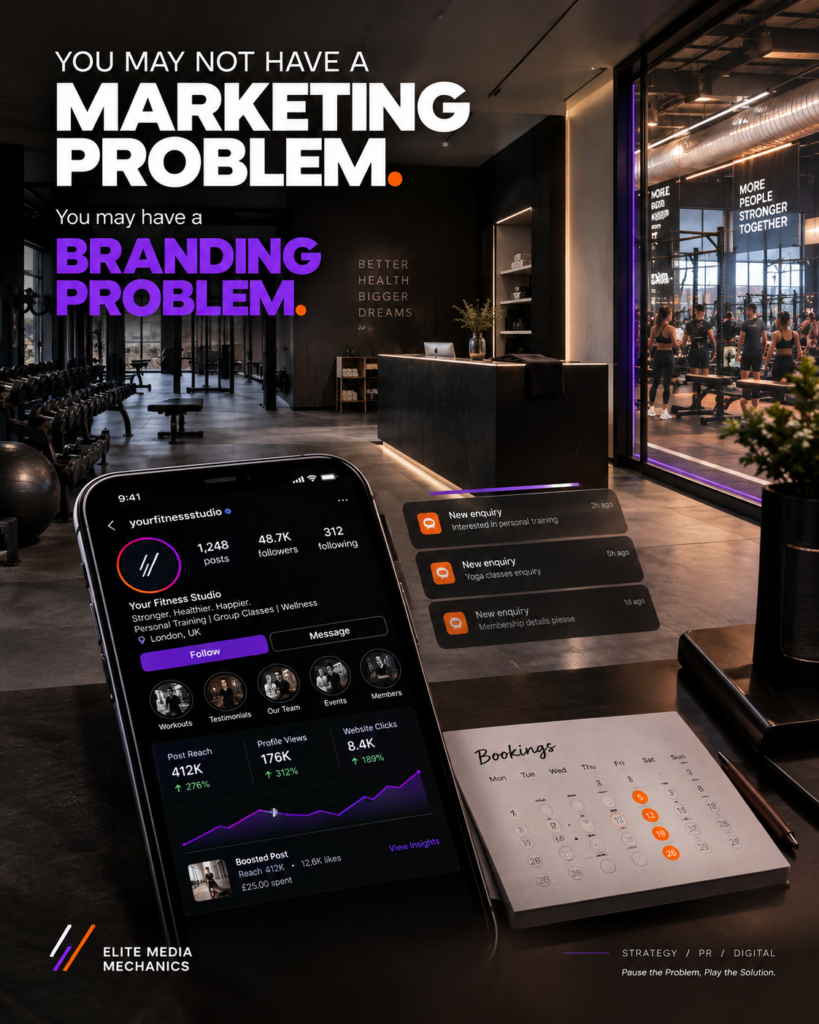
Here’s the uncomfortable truth most marketing agencies won’t tell you: you may not have a marketing problem at all.
You have a branding problem.
And there’s a critical difference between the two — one that could be costing your business tens of thousands of pounds, dollars, or rupees every single year.
Branding vs. Marketing: The Mechanic’s Breakdown
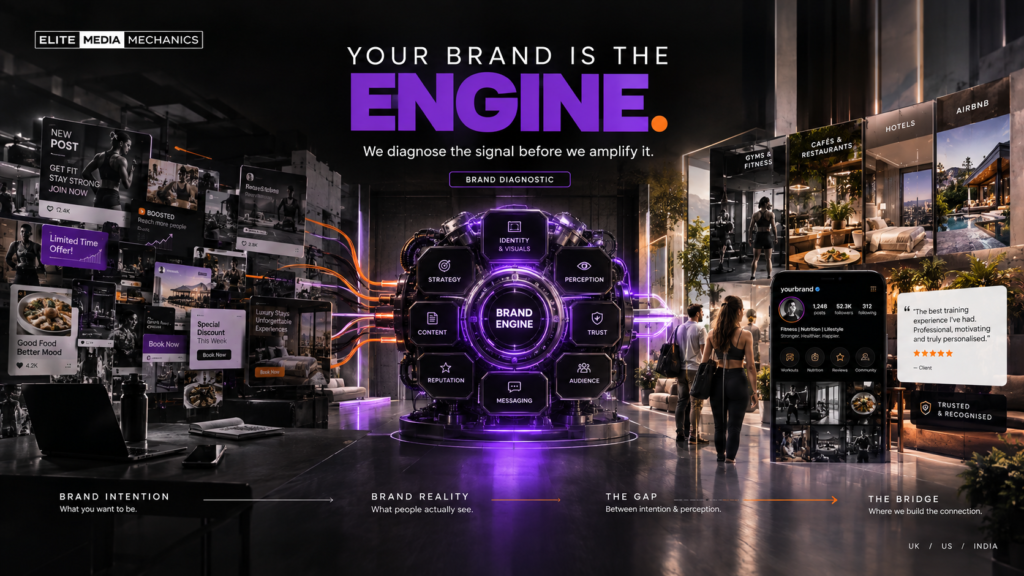
Think of your business like a car. Branding is the engine. It’s what powers everything — your identity, your values, your voice, the emotional reason people choose you over the gym across the street or the café down the road. Marketing is the accelerator. It takes what’s already built and pushes it forward — ads, social posts, email campaigns, reels.
Now here’s the problem: most small businesses in the UK, US, and India are pressing the accelerator on an engine that hasn’t been properly built yet. The result? Noise. Spend. Frustration. And very little return. You can pour money into Google Ads or Instagram promotions, but if your brand doesn’t clearly communicate who you are, who you serve, and why you’re different — you’re just paying to confuse people faster.
What the Data Actually Says in 2026
This isn’t opinion. The numbers are clear.
According to recent branding research, 81% of consumers say they need to trust a brand before they will consider buying from it. Not like it. Not follow it. Trust it.
And trust doesn’t come from a sponsored post. It comes from consistent, coherent branding that shows up the same way — every time, everywhere.
Here’s what that consistency is worth: businesses that maintain consistent branding across all their channels report up to 33% higher revenue growth compared to those that don’t. Meanwhile, brands that are inconsistent have to spend nearly 1.75 times more on advertising just to achieve the same result as a brand-consistent competitor.
Let that sink in. You’re not just losing customers — you’re paying more to lose them.
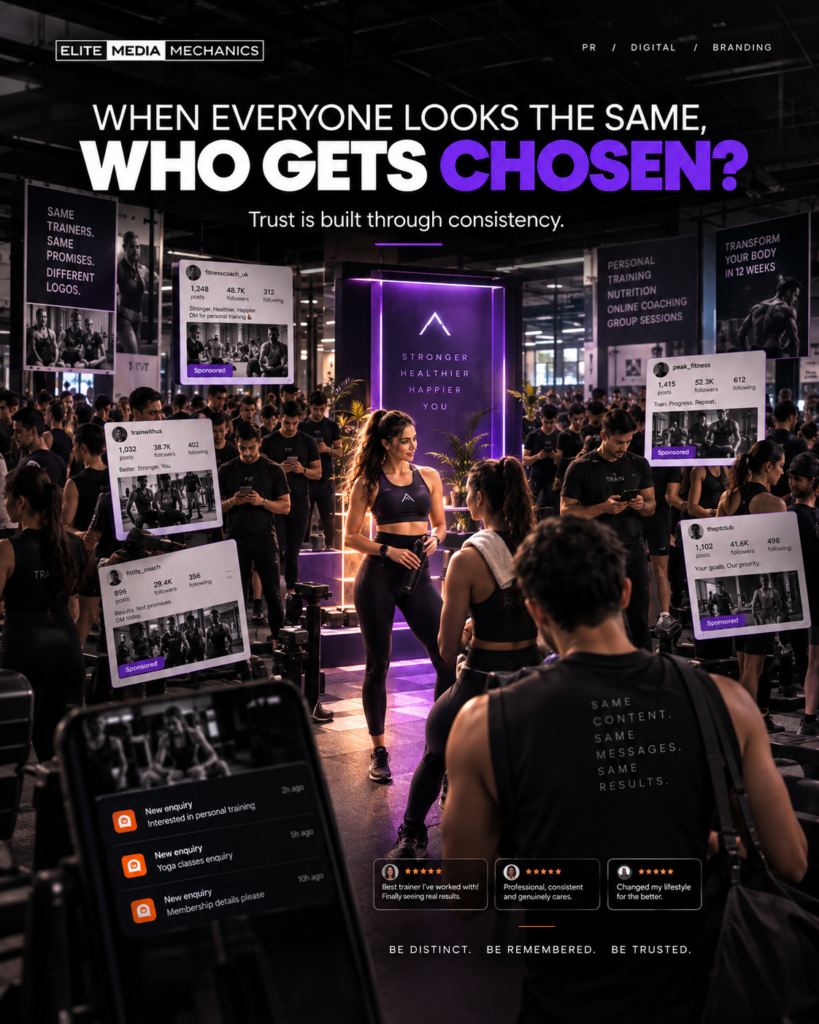
And in the fitness industry specifically, the numbers reflect a crisis of identity. Four in five personal trainers say finding new clients has gotten harder or plateaued — not because there aren’t enough people looking for a trainer, but because the market is saturated with coaches who all look, sound, and present themselves the same way. Generic logo. Generic captions. Generic everything.
The global personal fitness training market is valued at $15.6 billion in 2026 — and yet over 50% of trainers still rely primarily on word-of-mouth to get clients. Not because word-of-mouth is wrong, but because their brand isn’t strong enough to do any of the heavy lifting on its own.
The Three Symptoms of a Branding Problem (Disguised as a Marketing Problem)
1. Your Ads Get Clicks — But No Conversions
If people are clicking your ads but not booking, not calling, not walking in — the ad isn’t the problem. The landing page, the Instagram profile, the website they land on — that’s where the trust breaks down.
Your marketing brought them to the door. Your branding (or lack of it) sent them away.
This is one of the most expensive patterns we see across all three markets. A gym in the UK runs Facebook ads, gets 200 clicks a day, but nobody books a trial. A restaurant in India runs Google Ads, gets visitors to their website, but the enquiry form stays empty. A café in the US boosts Instagram posts, gets reach, but footfall doesn’t move.
In every case, the channel isn’t the problem. The destination is. And the destination is almost always a brand signal that breaks down the moment someone arrives.
2. You’re Competing on Price
When your brand has no clear identity, the only differentiator left is how cheap you are. Gyms discount memberships. Cafés run endless meal deals. Hotels compete on price comparison sites.
But here’s what the data shows: 42% of consumers will pay more for a brand they trust. When your brand communicates premium value clearly — you stop competing on price. You start competing on perception. And perception is where the real money is.
The businesses that never have to discount are almost always the ones with the clearest brand identity. They haven’t escaped price competition by luck — they’ve escaped it by building a brand so coherent, so consistent, so clear about who it’s for and what it delivers, that price becomes a secondary conversation.
3. You Have Followers But Not Fans
A high follower count with low engagement isn’t a social media problem. It’s a branding problem. People follow interesting content, but they buy from brands they feel connected to.
According to the 2025 Edelman Brand Trust report, 80% of people trust brands they personally use — more than they trust businesses, media, or even their employers.
That trust is built through emotional consistency: your tone of voice, your visual identity, your story, the feeling someone gets every time they interact with you — online or in person.
If your Instagram feels different from your website, which feels different from the experience inside your gym or café — the brand is broken. And no amount of marketing will fix a broken brand.1. Your Ads Get Clicks — But No Conversions
If people are clicking your ads but not booking, not calling, not walking in — the ad isn’t the problem. The landing page, the Instagram profile, the website they land on — that’s where the trust breaks down.
Your marketing brought them to the door. Your branding (or lack of it) sent them away.
This is one of the most expensive patterns we see across all three markets. A gym in the UK runs Facebook ads, gets 200 clicks a day, but nobody books a trial. A restaurant in India runs Google Ads, gets visitors to their website, but the enquiry form stays empty. A café in the US boosts Instagram posts, gets reach, but footfall doesn’t move.
In every case, the channel isn’t the problem. The destination is. And the destination is almost always a brand signal that breaks down the moment someone arrives.
2. You’re Competing on Price
When your brand has no clear identity, the only differentiator left is how cheap you are. Gyms discount memberships. Cafés run endless meal deals. Hotels compete on price comparison sites.
But here’s what the data shows: 42% of consumers will pay more for a brand they trust. When your brand communicates premium value clearly — you stop competing on price. You start competing on perception. And perception is where the real money is.
The businesses that never have to discount are almost always the ones with the clearest brand identity. They haven’t escaped price competition by luck — they’ve escaped it by building a brand so coherent, so consistent, so clear about who it’s for and what it delivers, that price becomes a secondary conversation.
3. You Have Followers But Not Fans
A high follower count with low engagement isn’t a social media problem. It’s a branding problem. People follow interesting content, but they buy from brands they feel connected to.
According to the 2025 Edelman Brand Trust report, 80% of people trust brands they personally use — more than they trust businesses, media, or even their employers.
That trust is built through emotional consistency: your tone of voice, your visual identity, your story, the feeling someone gets every time they interact with you — online or in person.
If your Instagram feels different from your website, which feels different from the experience inside your gym or café — the brand is broken. And no amount of marketing will fix a broken brand.
The Industries Getting This Wrong (And It’s Costing Them)
Gyms & Personal Trainers
The fitness industry is undergoing a significant shift in 2026. According to a NASM survey of over 600 fitness professionals, clients are no longer driven primarily by how they look — but by how they live. Longevity, mental health, and functional strength have replaced aesthetics as the dominant client motivation.
Yet most gyms are still marketing six-packs and weight loss. Their brand is stuck in 2015 while their audience has evolved entirely.
The result? Studios that have updated their brand positioning — around longevity, community, and holistic wellbeing — are seeing membership retention improve, while traditional gyms are reporting cancellations rising by 8% year-over-year.
The gym that markets “get lean” to an audience that now wants “feel strong for life” isn’t just behind on trends. Its brand is speaking the wrong language to the right people.
Personal trainers face an even more specific challenge. With thousands of coaches available online — on Instagram, on YouTube, on every digital platform — the trainers who win clients consistently are not the most qualified. They’re the ones with the clearest brand identity. The ones whose potential clients feel like they already know them before the first consultation. The ones who have built enough brand trust that pricing becomes almost irrelevant.
Cafés & Restaurants
The hospitality sector in the UK, US, and India faces a common crisis: every café claims to be “cosy and welcoming.” Every restaurant claims to serve “fresh, authentic food.”
These aren’t brands. These are generic descriptions.
When a customer in Manchester, Mumbai, or Miami searches for somewhere to eat or drink — they’re not just searching for food. They’re searching for an experience, an identity, a place that matches who they are. Research consistently shows that 73% of people prefer brands that communicate through stories rather than direct advertising.
Your café has a story. Your restaurant has a personality. But if your branding doesn’t communicate it — you’re invisible in a crowded market. And invisible businesses compete only on price, location, and luck. None of those are sustainable growth strategies.
The cafés and restaurants we’ve seen grow sustainably — in Mysore, in London, in New York — share one thing: a brand identity so clear that customers become advocates without being asked. They don’t just return; they bring people. They post about you. They recommend you without prompting. That level of loyalty isn’t built by a loyalty card. It’s built by a brand.
Hotels & Airbnb Hosts
Travel decisions are deeply emotional. Uncertainty kills bookings.
In 2026, travellers don’t just browse prices — they research brands. They scroll Instagram, read reviews, watch reels, and form a complete impression of a property before they even check availability.
A hotel or Airbnb with a clear brand identity — a defined visual style, a consistent tone of voice, a sense of place and personality — wins the booking before the price comparison even happens.
A property without a brand is just a bed in a building. And beds in buildings are chosen purely by price. That’s a race to the bottom.
We’ve seen this play out directly in our work with hospitality clients. Properties that invest in brand identity — a coherent visual presence, a consistent story across platforms, a clear value proposition that goes beyond “comfortable rooms” — are the ones generating direct bookings at a premium, while their competitors are stuck paying OTA commissions just to stay visible.
What Fixing Your Brand Actually Looks Like
Branding isn’t a rebrand. It’s not a new logo or a colour palette change. It’s not even a new website.
Brand repair is a diagnostic process.
It starts with the right questions:
Who are you, specifically? Not “we’re a friendly gym” — but what do you actually stand for? What do you refuse to be?
Who is your customer, precisely? Not “anyone who wants to get fit” — but the exact person, their mindset, their frustration, their aspiration.
What do you sound like? Is your tone the same in your Instagram captions, your WhatsApp replies, your signage, and your website copy?
What is the one thing you want someone to feel the first time they encounter your brand?
What makes you genuinely, specifically different from the three other businesses in your category within five miles?
When these questions are answered clearly and consistently, something remarkable happens. Marketing becomes easier. Ads perform better. Word-of-mouth accelerates. And price objections disappear — because people aren’t choosing between options anymore. They’re choosing you.
The 5 Signs Your Business Has a Brand Problem, Not a Marketing Problem
Use this as a quick self-audit. If you recognise more than two of these, the fix starts with brand — not with more spend.
Sign 1: Your social media looks different from your website, which looks different from the experience inside your business. Inconsistency is the most visible symptom of an unbuilt brand. If a customer moves between your platforms and feels like they’re encountering a different business each time, trust breaks down at every transition.
Sign 2: You struggle to explain what makes you different in one sentence. If you can’t say it in one sentence, your customers can’t remember it. And if they can’t remember it, they can’t recommend you. A clear brand identity gives you a one-sentence answer that your customers can repeat to their friends.
Sign 3: Your best customers are very different from the customers your marketing attracts. This is a brand-audience mismatch. Your marketing is speaking to the wrong people because your brand positioning hasn’t clearly defined who the right people are.
Sign 4: You’ve had to discount to close sales. A strong brand never competes on price because it has already won on value perception. If you’re regularly discounting to close, the brand hasn’t done its job before the sales conversation begins.
Sign 5: Your ads get reach but not results. Reach means people saw you. Results mean people trusted you enough to act. If the gap between the two is large, the ad isn’t underperforming — the brand it’s pointing to is.
The New Brand Reality for 2026 and Beyond
Here’s where the world is heading — and it changes everything for local businesses.
In 2026, AI-powered search platforms — Google’s AI Overviews, ChatGPT, Perplexity — are not just search engines. They are recommendation engines. When someone asks “best gym near me with a strong community focus” or “most authentic Indian restaurant in London,” AI platforms compile answers based on brand reputation, content clarity, and digital consistency.
If your brand doesn’t have a clear, coherent identity across the web, you don’t just lose on Google — you become invisible to AI discovery entirely.
This creates an urgent new argument for brand investment: brands that are unclear or inconsistent are increasingly unreadable by AI systems. And unreadable brands don’t get recommended. They get skipped.
The businesses winning the next five years won’t be the ones with the biggest ad budgets. They’ll be the ones with the clearest brand signal — the businesses that AI, algorithms, and real humans can understand, trust, and recommend instantly.
And the good news? Most of your competitors haven’t figured this out yet.
The Elite Media Mechanics Approach
At Elite Media Mechanics, we don’t start with your Instagram grid or your ad account. We start with your brand engine — because without that, everything else is just noise.
We call our process the Brand Diagnostic: a structured audit of how your business is perceived versus how it actually performs. We identify the exact gap between your brand intention and your brand reality — and then we build the bridge.
We work with gyms, personal trainers, cafés, restaurants, hotels, and Airbnb hosts across the UK, US, and India — and the single most common finding is this:
The business isn’t broken. The brand signal is.
If people aren’t finding you, trusting you, or choosing you — it’s almost never a marketing spend problem. It’s a brand clarity problem.
Pause the problem. Play the solution.
Frequently Asked Questions
What is the difference between branding and marketing?
Branding is the foundation — your identity, your values, your voice, and the emotional reason people choose you. Marketing is the mechanism that amplifies that foundation — your ads, content, and campaigns. Marketing without branding is like accelerating a car with a broken engine. You create noise but no meaningful forward movement.
How do I know if I have a branding problem or a marketing problem?
If your ads are getting clicks but no conversions, if you’re competing on price more than you’d like, or if your followers aren’t converting into paying customers — these are almost always brand problems disguised as marketing problems. The fix starts with a brand audit, not a new ad campaign.
How long does it take to fix a brand?
Brand repair isn’t a single event — it’s a structured process. A full brand diagnostic and strategy build typically takes 2–4 weeks. Implementing the new brand across all digital touchpoints takes another 4–8 weeks. You’ll typically see measurable improvements in conversion and trust signals within the first 90 days.
Can a small business afford to invest in branding?
The more useful question is: can a small business afford not to? Businesses that invest in brand consistency report up to 33% higher revenue growth. Businesses that skip it spend 1.75x more on advertising to achieve the same result. Branding isn’t a luxury — it’s the investment that makes every other investment work harder.
Does branding apply to online businesses, or only physical locations?
It applies to both — arguably more so to online businesses, where the physical experience can’t compensate for a weak digital identity. For gyms, cafés, hotels, and healthcare brands operating in the UK, US, and India, brand consistency across digital touchpoints (website, social, GBP, reviews) is now the primary driver of trust.
What does a brand audit actually involve?
A brand audit examines every digital touchpoint your customer encounters — your website, social profiles, Google Business Profile, reviews, visual identity, and tone of voice — and measures them against what your brand should be communicating. The output is a clear diagnosis of gaps and a prioritised action plan for closing them.
Ready to Find Out What Your Brand Is Actually Saying?
If you’ve been running ads, posting content, and still not seeing the growth you expected — your brand might be sending a message you didn’t intend.
We offer a complimentary Invisible Brand Audit for businesses that are ready to stop guessing and start growing.
Keywords: branding vs marketing, gym branding 2026, personal trainer brand strategy, café marketing UK, restaurant branding India, hotel digital marketing, small business branding, brand trust statistics, digital marketing agency UK, brand consistency revenue, fitness industry marketing, Airbnb brand strategy, local business branding, brand identity for gyms, Elite Media Mechanics