By Elite Media Mechanics | Digital Marketing & PR Agency | UK · US · India
“98.8% of local businesses are invisible to AI search right now. The question isn’t whether this shift is happening. It’s whether you’re one of the 1.2% that AI actually recommends.”
A Search Behaviour Shift That Happened Almost Overnight
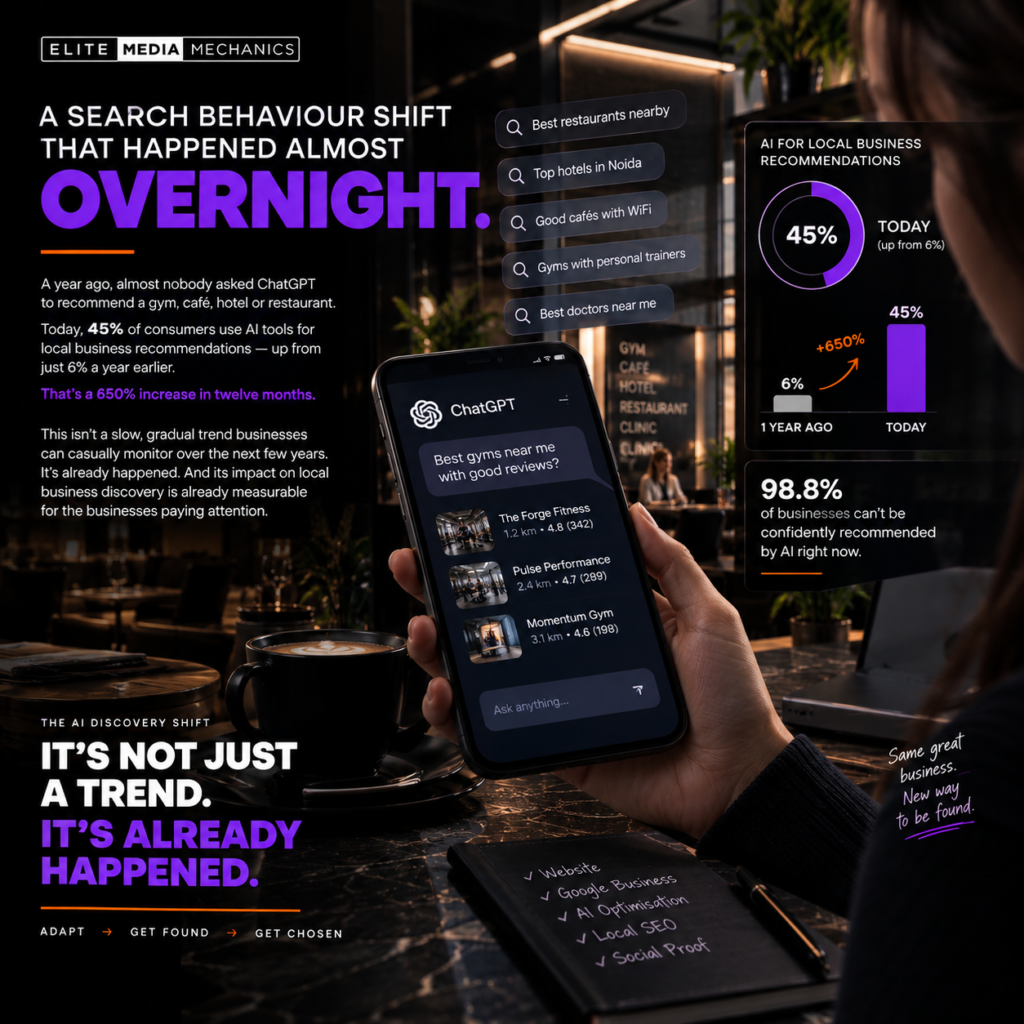
A year ago, almost nobody asked ChatGPT to recommend a gym, café, hotel, or restaurant. Today, 45% of consumers use AI tools for local business recommendations — up from just 6% a year earlier. That’s a 650% increase in twelve months.
This isn’t a slow, gradual trend businesses can casually monitor over the next few years. It’s already happened. And its impact on local business discovery is already measurable for the businesses paying attention.
The question is no longer whether AI search matters for your business. It does. The question is whether your business has adapted — or whether you’re one of the 98.8% that AI search currently cannot confidently recommend.
What’s Actually Happening Behind the Scenes
Search no longer works the way it did even two years ago. Understanding what has actually changed is the first step to adapting correctly.
When someone searches Google today, there’s a strong chance they see an AI Overview — a grey box with a generated answer — sitting above the traditional list of blue links. These AI-generated summaries now appear in roughly 25% to 40% of search queries, with some categories (including local, informational searches — exactly the kind people make when looking for a gym, restaurant, or hotel) triggering them at rates as high as 48%.
What this means in practice: when someone searches “best yoga studio for beginners in [city],” they may see an AI-generated answer before they see a single link. That answer names specific businesses. It describes why those businesses were recommended. And if your business isn’t named in that answer — you’ve been invisible in that search, even if you rank on page one of traditional results.
Meanwhile, ChatGPT has grown to 883 million monthly users, processing 2 billion queries every single day — making it the fifth most visited website in the world. Perplexity, Claude, and other AI platforms are growing rapidly alongside it. The combined daily volume of AI search queries has grown by over 500% year-over-year.
Here’s the part that matters most: when someone asks an AI assistant “best gym near me” or “good Italian restaurant for a date night,” your Google ranking often has nothing to do with the answer they receive. The AI is pulling directly from reviews, business directories, website content, and structured data to construct its own recommendation. If your information isn’t clean, consistent, and authoritative in those sources — you don’t exist in that conversation.
The Number That Should Concern Every Local Business Owner
Recent industry research found something striking: only 1.2% of local businesses are currently being recommended by AI search tools. The remaining 98.8% are essentially invisible.
This isn’t because those businesses are poor quality. Many of them are excellent businesses with loyal customers. It’s because most of them have never structured their digital presence in a way AI systems can accurately read, confidently trust, and reliably cite.
This creates an unusual moment in marketing history — a genuine first-mover advantage. Because so few businesses have adapted to AI search requirements yet, the ones who do now have a real opportunity to dominate AI recommendations in their category before their competitors even realise the shift has happened.
The window for that advantage is closing. Slowly — but closing.
How AI Search Actually Decides Who to Recommend
This is where most business owners get confused — because AI recommendation doesn’t work like traditional SEO, and the ranking signals are different in ways that aren’t obvious.
Traditional SEO focuses on keywords, backlinks, and technical page structure. AI recommendation focuses on something more holistic: can this AI tool understand your business well enough to confidently describe it to someone looking for exactly what you offer?
The specific signals AI platforms evaluate include:
Content clarity: Does your website directly and clearly answer the questions customers are likely to ask? Not in marketing language — in plain, specific terms. “We’re a boutique hotel with 12 rooms, a rooftop terrace, free parking, and late checkout available on request” is the kind of content AI tools can extract and cite. “We offer an unforgettable hospitality experience” is not.
Review signals: Are your reviews recent? Are they detailed? Do they mention specific things about your business (the specific dish they ordered, the room type they stayed in, the trainer who helped them)? Detailed, recent reviews give AI tools the specific evidence they need to recommend you with confidence.
Business information consistency: Does your business name, address, phone number, and website URL match exactly across every platform it appears on? Inconsistencies signal unreliability to AI systems evaluating whether to recommend you.
Topical authority: Does your website demonstrate genuine expertise in your field? A gym with a detailed blog about training methodology, nutrition guidance, and recovery science is a more authoritative source than one with a single-paragraph homepage and no other content.
Schema markup: Does your website include structured data (schema markup) that explicitly tells AI systems what category of business you are, where you’re located, what your hours are, and what specific services you offer? Schema is the technical language that makes your content machine-readable.
Why Your Google Business Profile Just Became More Important Than Ever
In the AI era, your Google Business Profile has undergone a fundamental change in function. It’s no longer primarily a directory listing. It functions as a living entity database — one of the core sources AI systems pull from to understand what your business is, what it offers, and whether it’s trustworthy enough to recommend.
When an AI platform receives a query about a local business category, it frequently cross-references Google Business Profile data alongside website content and review signals. A profile that hasn’t been updated in 30 days shows reduced visibility in AI recommendations. A complete, consistently active, well-maintained profile is now one of the single most powerful levers a local business can pull for AI search visibility.
Specifically, a GBP optimised for AI visibility should have:
- Accurate, consistent business name, address, and phone number
- Correct and complete business categories (not just primary — secondary categories matter)
- Fresh photos added at least monthly
- Regular posts (updates, offers, events) at least biweekly
- Responses to every review — within 48 hours where possible
- Complete Q&A section with pre-answered common questions
- Products or services listed with clear descriptions and pricing where applicable
This is the same Google Business Profile most businesses set up once and never touch again. In 2026, that neglect is actively costing them AI visibility.
What This Means Specifically for Different Business Types
For gyms and personal trainers: When someone asks an AI “best personal trainer for weight loss in [city]” or “gym with the best community in [area],” the AI recommends the studios and trainers whose content most clearly and specifically answers those questions. A gym with a detailed FAQ about its training philosophy, its community culture, its class structure, and its results process will consistently outperform a competitor with a generic homepage and no supporting content.
For cafés and restaurants: Queries like “café with good working environment near [location]” or “best brunch spot in [city] with vegan options” are increasingly being answered by AI before a user sees a single search result. The restaurants appearing in those AI answers have detailed, specific content about their menu, their atmosphere, their dietary accommodations, and their unique identity — not just a name and address.
For hotels and Airbnb hosts: Travel planning is one of the most common use cases for AI assistants. “Boutique hotel in [destination] with a pool and free cancellation” is exactly the kind of query AI tools handle well — and the properties they recommend are the ones with the most complete, accurate, and structured digital presence. Room descriptions, amenity lists, cancellation policies, nearby attraction information — all of this becomes AI-readable content that drives recommendation.
For healthcare clinics: Queries like “homeopathy clinic with good reviews near me” or “physiotherapy with evening appointments in [city]” are increasingly AI-mediated. Clinics with detailed content about their treatment approach, their practitioners’ qualifications, their appointment process, and a strong, recent review base are the ones being recommended.
The Honest Timeline: This Isn’t Instant, But It’s Faster Than You’d Expect
Based on implementation data from businesses that have correctly applied AI visibility principles, measurable improvement in AI search appearance typically follows within 8 to 12 weeks of making the right structural changes.
That’s remarkably fast compared to traditional SEO, which often takes 6 months to a year to produce meaningful ranking movement. For businesses willing to start now, this represents one of the highest-return, fastest-impact investments in digital marketing currently available.
The core changes — fixing business information consistency, completing the Google Business Profile, adding FAQ content, and implementing basic schema markup — are not technically complex. They’re time-consuming and require attention to detail. But they don’t require a large budget. They require the right understanding of what AI systems are looking for.
The Mistake to Avoid: Keyword-Stuffing Your Business Name
It’s tempting, when learning about AI search, to think that the fix is simply adding descriptive keywords to your business name everywhere. Calling yourself “Best Personal Trainer in [City]” instead of your actual business name. Adding “Award-Winning” or “Top-Rated” before your business name in your Google Business Profile.
Don’t.
AI systems in 2026 are increasingly sophisticated at identifying exactly this kind of manipulation. Keyword-stuffed business names are flagged as untrustworthiness signals rather than helpful ones. Google has also taken an increasingly hard line on businesses that violate their naming guidelines in this way, with penalties including suspension of the Business Profile.
The businesses that win AI visibility are the ones being genuinely clear, accurate, and consistent — not the ones trying to game the algorithm. In an AI-driven search environment, authenticity and accuracy are the algorithm.
A Practical AI Visibility Checklist for Local Businesses
Use this as a starting point to evaluate your current AI search readiness:
Business information:
- My business name is identical across my website, Google Business Profile, Facebook, Instagram, and every directory I appear on
- My address (including formatting — whether “Street” is abbreviated “St” or written in full) is identical everywhere
- My phone number is correct and identical across all platforms
- My website URL is the same everywhere and points to my current website
Google Business Profile:
- All business categories are complete and accurate
- Photos were added within the last 30 days
- All reviews (including negative ones) have received a response
- The Q&A section has been populated with answers to common questions
- I’ve posted an update, offer, or event within the last two weeks
Website content:
- My homepage clearly explains what I do, who I serve, and what makes me different
- My service or product pages have at least 300–500 words of specific, detailed content
- I have an FAQ section on my website that answers the most common customer questions
- My website includes my business name, location, and phone number in the footer on every page
- Schema markup (LocalBusiness schema at minimum) has been implemented
Reviews:
- I have at least 20 Google reviews
- My most recent review was left within the last 30 days
- My average rating is 4.0 or above
- All negative reviews have been responded to professionally
Frequently Asked Questions
What is Generative Engine Optimisation (GEO)? GEO is the discipline of structuring your digital presence so that AI-powered platforms — including ChatGPT, Google AI Overviews, and Perplexity — can accurately understand, represent, and recommend your business. It differs from traditional SEO in that it focuses on content clarity, information consistency, and structured data rather than keyword density and backlinks.
Does AI search affect businesses in India and the UK as well as the US? Yes — AI search adoption is global and growing across all three markets. India, the UK, and the US are all seeing significant growth in AI assistant usage for local business discovery. In India specifically, where mobile-first internet usage is dominant, AI search adoption has accelerated particularly quickly.
How is AI search different from traditional SEO? Traditional SEO focused on ranking your pages for specific keywords. AI search focuses on whether an AI system can confidently understand and describe your business. The shift is from keyword optimisation to clarity, authority, and information structure. Content that answers specific questions clearly, business information that is consistent and complete, and reviews that provide specific detail are the currency of AI search.
If I already rank on Google page one, do I still need to worry about AI search? Yes — and this is critical. Businesses that rank well on traditional Google are finding that they’re losing visibility as AI Overviews answer questions before users reach the organic results. Click-through rates on traditional organic results have dropped by up to 60% on queries where an AI Overview appears. Ranking is no longer enough. Being cited is what matters now.
How much does it cost to improve AI search visibility? The foundational steps — fixing business information consistency, completing your Google Business Profile, adding FAQ content, implementing schema markup — require time more than budget. They can be done independently or with professional support. More advanced AI visibility work (topical authority building, structured content ecosystems, schema optimisation) benefits from professional expertise but doesn’t require the ad budget that paid marketing demands.
Is AI search the same on ChatGPT and Google? No — each platform has its own data sources and recommendation logic. However, they pull from many of the same underlying sources: Google Business Profile, review platforms, business directories, and structured website content. A business that optimises for one tends to benefit across all, because the underlying requirements — clarity, consistency, authority — are the same.
How Elite Media Mechanics Prepares Brands for AI Discovery
We build brand presences designed to be understood — by humans and by the AI systems increasingly standing between your business and your next customer.
Our Invisible Brand Audit identifies exactly where your digital presence is failing to meet the structural, consistency, and content standards AI platforms now require — across your website, Google Business Profile, and review ecosystem.
We work with gyms, personal trainers, cafés, restaurants, hotels, and Airbnb hosts across the UK, US, and India, helping brands move from invisible to recommended before their competitors even realise the shift has happened.
Pause the problem. Play the solution.
Elite Media Mechanics is a full-service Digital Marketing & PR agency working with fitness, hospitality, and lifestyle brands across the UK, US, and India. We don't do generic. We fix brands.
Keywords: AI search local business, Generative Engine Optimization, Answer Engine Optimization, ChatGPT local recommendations, Google AI Overviews, AI visibility small business, GEO marketing 2026, local SEO UK US India, Elite Media Mechanics
© 2026 Elite Media Mechanics. All rights reserved.