
Why Your Restaurant or Hotel Isn’t Getting Bookings — Your Digital Presence Is Broken
By Elite Media Mechanics | Digital Marketing & PR Agency | UK · US · India
“Your food is incredible. Your rooms are beautiful. None of that matters if your digital presence tells a different story before guests ever walk through the door.”
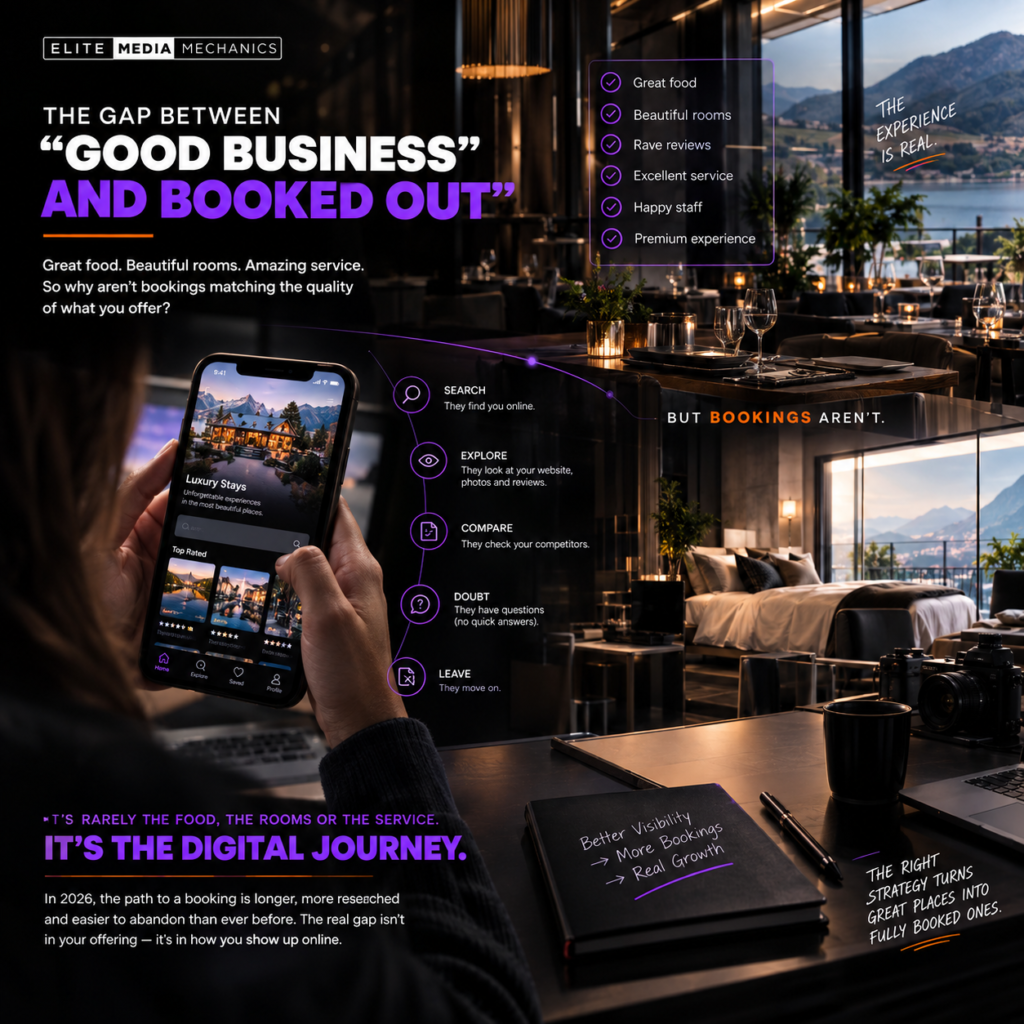
The Gap Between “Good Business” and “Booked Out”
You run a great restaurant. Or a beautiful boutique hotel. Or a charming homestay that guests rave about once they arrive. The reviews you do have are excellent. The experience you deliver is genuinely premium. Staff morale is good. The product is right.
So why aren’t bookings matching the quality of what you offer?
This is one of the most frustrating situations in hospitality — and one of the most common. The owners we work with across the UK, US, and India who describe this gap almost always share one characteristic: they’ve invested significantly in the physical experience and very little in the digital path that leads someone to it.
Here’s the diagnosis we give almost every hospitality client we audit: it’s rarely the food, the rooms, or the service. It’s the digital journey someone takes before they ever experience any of it. And in 2026, that journey is longer, more researched, and more easily abandoned than it has ever been.
How Modern Guests Actually Make Booking Decisions
Before we get into the specific problems, it helps to understand the modern guest’s booking behaviour — because it’s significantly more complex than it was even two years ago.
A traveller planning a weekend trip in 2026 might start by asking an AI assistant for hotel recommendations. They’ll then check the suggested properties on Instagram to assess the visual identity. They’ll read the three most recent Google reviews to check for red flags. They’ll visit the hotel website to look at specific room types and check pricing. They’ll compare with a price on Booking.com. They’ll look for a response from the hotel to a negative review they spotted. They’ll check if the Instagram was updated in the last two weeks.
Only then — after this entire multi-platform research process — will they decide whether to book.
This isn’t unusual behaviour. It’s typical. And it means that losing a booking isn’t one failure — it’s usually the accumulation of several small frictions across different digital touchpoints, each one adding a small amount of uncertainty until the guest decides the risk isn’t worth it.
The guest who didn’t book your restaurant last Friday didn’t decide your food wasn’t good. They decided your online presence didn’t reassure them enough to take the risk of a special occasion.
The Brutal Math of Hotel Conversion
Let’s start with hotels, because the numbers here are sobering for most independent properties.
The average hotel website conversion rate sits between roughly 2.2% and 3.9% — meaning out of every 100 people who land on your website, fewer than 4 actually complete a booking. High-performing boutique properties can push past 5%, but most independent hotels never get close to that.
Compare that to OTAs like Booking.com or Expedia, which convert at 12% to 15% — not because they’re better at selling your property, but because guests arrive there with stronger purchase intent and trust the platform’s guarantee and payment process.
But here’s where the financial reality becomes acute: acquiring a booking through an OTA now costs hotels between 15% and 30% in commission per booking, while a direct booking through your own website costs roughly 2% to 5% in processing and platform fees. Direct bookers are also statistically 60% more valuable over their lifetime — they book premium rooms more frequently, show stronger brand loyalty, and return without prompting.
The maths is clear. Every direct booking that becomes an OTA booking instead costs you between 10% and 28% of revenue. For a hotel doing £20,000 in monthly revenue, that’s potentially £2,000–£5,600 per month leaking to commission fees — from guests who would have booked directly if the website had given them a reason to.
The Billboard Effect — And Why It Costs You the Most Critical Moment
Cornell University’s School of Hotel Administration identified a phenomenon that still plays out daily for independent hotels in 2026. They called it the Billboard Effect.
It works like this: a guest discovers your property on an OTA — Booking.com, Expedia, or a similar platform. The property looks appealing. Rather than booking immediately through the OTA, they visit the hotel’s own website directly — either to check for a better rate, to see more photos, to get a sense of the property’s personality, or simply because they prefer booking direct.
This is the moment of maximum purchase intent. The guest is on your website, actively looking for a reason to stay there and book.
And this is where most independent hotels lose them.
The website is slow to load. The booking button isn’t immediately obvious. The photo gallery is outdated. The room descriptions are generic. There’s no answer to whether parking is included. Breakfast availability isn’t clear. The mobile experience is broken. The guest waits three seconds for a page to load, doesn’t immediately find what they’re looking for, and goes back to the OTA to book — paying you 15–30% less than if they’d booked direct.
The number one reason guests abandon a direct booking attempt is uncertainty. A simple unanswered question — “Is parking included?” or “What time is checkout?” — that isn’t resolved within seconds is often the precise moment a booking is lost. Not because the guest decided against the property. Because they decided it was easier to book somewhere that made them feel certain.
The Restaurant Side: Reviews Are Running Your Business Whether You Know It or Not
For restaurants, the digital booking problem looks different but runs just as deep.
88% of diners trust online reviews as much as a personal recommendation from a friend. Nearly 97% of consumers read reviews before choosing a local restaurant, and they consult an average of 6 different platforms before making a decision. For a special occasion — an anniversary dinner, a business lunch, a birthday — that research process can take hours.
Here’s the part most restaurant owners get wrong: they assume volume of reviews is the determining factor. More reviews equals more trust. More reviews equals better rankings.
It doesn’t work that simply.
73% of consumers only trust reviews written in the last month. A restaurant with 500 reviews accumulated over five years — where the most recent one is eight months old — performs significantly worse in consumer trust than a competitor with 50 reviews and a steady stream of fresh ones arriving weekly. The recency of reviews signals operational consistency. Old reviews signal a business that used to be good. Fresh reviews signal a business that is good right now.
The financial cost of ignoring this is substantial. One unaddressed negative review can drive away 30 out of 50 potential customers. For a restaurant with an average spend of even modest value per table, that’s meaningful lost revenue from a single review left unanswered.
And the opportunity cost of unmanaged positive reviews is equally significant. Diners who have a great experience and leave a review are effectively doing your marketing for you — but only if those reviews are recent, responded to, and visible. A positive review that sits unacknowledged for six months carries far less marketing weight than one that received a warm, personal response within 48 hours.
The Mobile Problem Nobody Is Talking About
Here’s a statistic that should concern every restaurant and hotel with a website: 78% of restaurant websites are not properly optimised for mobile, despite the fact that 59% of restaurant website traffic now comes from smartphones.
This means more than half of the potential customers arriving at your website are doing so on a mobile device — and more than three quarters of restaurant websites are delivering them a broken or substandard experience when they do.
The specific failure modes vary, but the most common are: PDF menus that don’t load properly on mobile, photo galleries that take too long to load on mobile data connections, booking forms that aren’t designed for thumb-friendly navigation, and font sizes that require pinching and zooming to read.
A guest trying to check your menu on their phone while deciding where to go for dinner will bounce within seconds if the experience is frustrating. They’ll choose the restaurant whose website gave them what they needed immediately — regardless of which restaurant actually has better food.
Five Specific Ways Your Digital Presence Might Be Broken Right Now
- Problem 1: Your Booking Flow Creates Friction, Not Flow
If a guest has to click through multiple steps, re-enter information, navigate unclear options, or wait more than three seconds for any page to load — they leave. Hotels with fast-loading, frictionless booking engines that answer the most common questions before the guest has to ask them consistently outperform competitors with clunky, unclear processes — even when the underlying product is comparable.
- Problem 2: Your Reviews Are Stale, Thin, or Unanswered
Stale reviews with no recent additions signal operational inconsistency. Unanswered reviews — particularly negative ones — signal that the management doesn’t care. Both damage AI search visibility, because AI platforms now use review recency and response rate as trust signals when deciding which businesses to recommend.
- Problem 3: Your Menu or Room Information Isn’t Built for Mobile
A PDF menu. A photo gallery that requires a fast Wi-Fi connection to load. A booking form that requires a desktop browser to complete properly. These aren’t small annoyances — they’re the difference between a conversion and a bounce in the moment that matters most.
- Problem 4: Your Google Business Profile Is Incomplete or Outdated
For both restaurants and hotels, a Google Business Profile has become the most influential first-impression tool most businesses own — more impactful for initial discovery than the website itself. Incorrect hours, missing photos, unanswered reviews, and an incomplete description don’t just hurt rankings. They actively reduce the likelihood that AI search platforms will recommend your business.
- Problem 5: You’re Not Answering Uncertainty Fast Enough
Whether it’s “is there parking,” “do you have vegan options,” “what’s the cancellation policy,” or “is the pool open in winter” — unanswered questions create uncertainty. Uncertainty delays decisions. Delayed decisions either result in abandonment or default to whichever platform answers the question fastest — which is usually an OTA, not your website.
The 2026 Shift: AI Discovery Is Now Part of Every Booking Journey
There is one more layer to the digital presence problem that most hospitality businesses haven’t caught onto yet — and it’s changing rapidly.
Hotels and restaurants with accurate, structured, regularly updated digital content are becoming easier for AI systems to interpret — meaning they’re more likely to be surfaced and recommended when a traveller asks an AI assistant for suggestions rather than typing a traditional search query.
Travellers are increasingly starting their search not with Google, but with AI. “Suggest a boutique hotel in [city] with a rooftop bar and flexible checkout.” “Best café in [area] with a quiet working environment and good coffee.” These queries are being handled by ChatGPT, Perplexity, and Google’s AI Overviews — and the properties they recommend are not chosen at random. They’re chosen based on which businesses have the clearest, most consistent, most authoritative digital presence.
A property with inconsistent information across platforms, thin website content, outdated photos, and stale reviews is simply harder for an AI to interpret — and AI tools don’t recommend businesses they can’t confidently describe. That property becomes invisible at the exact moment travel planning begins.
The Fix Isn’t More Marketing Spend — It’s a Digital Presence Repair
This is the most common mistake we see in hospitality marketing: a hotel or restaurant pours money into ads to drive more traffic to a website and a booking flow that is already leaking the guests it receives.
More traffic to a broken digital journey doesn’t create more bookings. It just means more people experiencing the same friction and the same uncertainty — and bouncing to a competitor or an OTA instead.
The fix starts with a precise diagnosis of where the digital journey breaks down. Every touchpoint — the Google Business Profile, the website booking flow, the review ecosystem, the mobile experience, the Instagram presence, the response rate on enquiries — needs to be evaluated and repaired before more traffic is worth paying for.
Frequently Asked Questions
Why are OTAs converting so much better than direct booking websites? OTAs convert better primarily because of trust and friction removal. Guests know the OTA, trust its guarantee, and have often stored their payment details there. The fix isn’t to be better than the OTA at everything — it’s to remove the specific barriers stopping guests from choosing direct. Clear information, a fast booking flow, a rate match guarantee, and a value-add for direct bookers (early check-in, a welcome drink, a discount) are usually enough to shift behaviour.
How many reviews does a restaurant or hotel need to perform well in local search? There’s no single magic number, but the research consistently points to two things mattering more than volume: recency and response rate. A business with 40 reviews written in the last 3 months and 100% response rate will typically outperform a business with 400 reviews written over 5 years and no responses.
What’s the fastest fix for a restaurant or hotel with a broken digital presence? In order of impact: (1) Audit and update your Google Business Profile — correct all information, add new photos, respond to all outstanding reviews. (2) Check your website on a mobile phone and fix the most obvious friction points. (3) Start a systematic review generation process. (4) Update your website content to answer the 10 most common questions guests ask before booking.
Does AI search matter for hospitality yet, or is it still early? It’s already significant and accelerating. 45% of consumers are using AI tools for local business recommendations as of 2026 — up from 6% a year earlier. For hospitality specifically, travel planning is one of the leading use cases for AI assistants. Properties that are AI-visible now will have a meaningful head start before competitors catch up.
How do I get guests to book direct rather than through OTAs? The most effective tactics are: a clear rate match guarantee on your website, a direct booking incentive (flexible cancellation, early check-in, free upgrade on availability), a fast and mobile-friendly booking flow, and a Google Business Profile that links directly to your booking page. The guest who is already on your website wants to book direct — remove the barriers and they will.
How Elite Media Mechanics Repairs Hospitality Brands
We treat your digital presence the way a mechanic treats an engine — diagnose first, then fix. Our Invisible Brand Auditidentifies exactly where guests are dropping off between discovery and booking, across your website, reviews, social presence, and Google Business Profile.
We work with restaurants, cafés, hotels, homestays, and Airbnb hosts across the UK, US, and India, building digital presences that convert lookers into bookers — not just followers into likes.
Pause the problem. Play the solution.
Elite Media Mechanics is a full-service Digital Marketing & PR agency working with fitness, hospitality, and lifestyle brands across the UK, US, and India. We don't do generic. We fix brands.
Keywords: hotel digital marketing 2026, restaurant online reviews, hotel direct bookings, restaurant website conversion, Google Business Profile hospitality, Airbnb marketing strategy, restaurant digital presence India, hotel marketing UK US, Billboard Effect hotels, booking conversion, Elite Media Mechanics
© 2026 Elite Media Mechanics. All rights reserved.