
By Elite Media Mechanics | Digital Marketing & PR Agency | UK · US · India
“Hashtags didn’t disappear. They just stopped being the strategy. In 2026, the businesses that understand the difference are the ones growing.”
The Moment Everything Changed
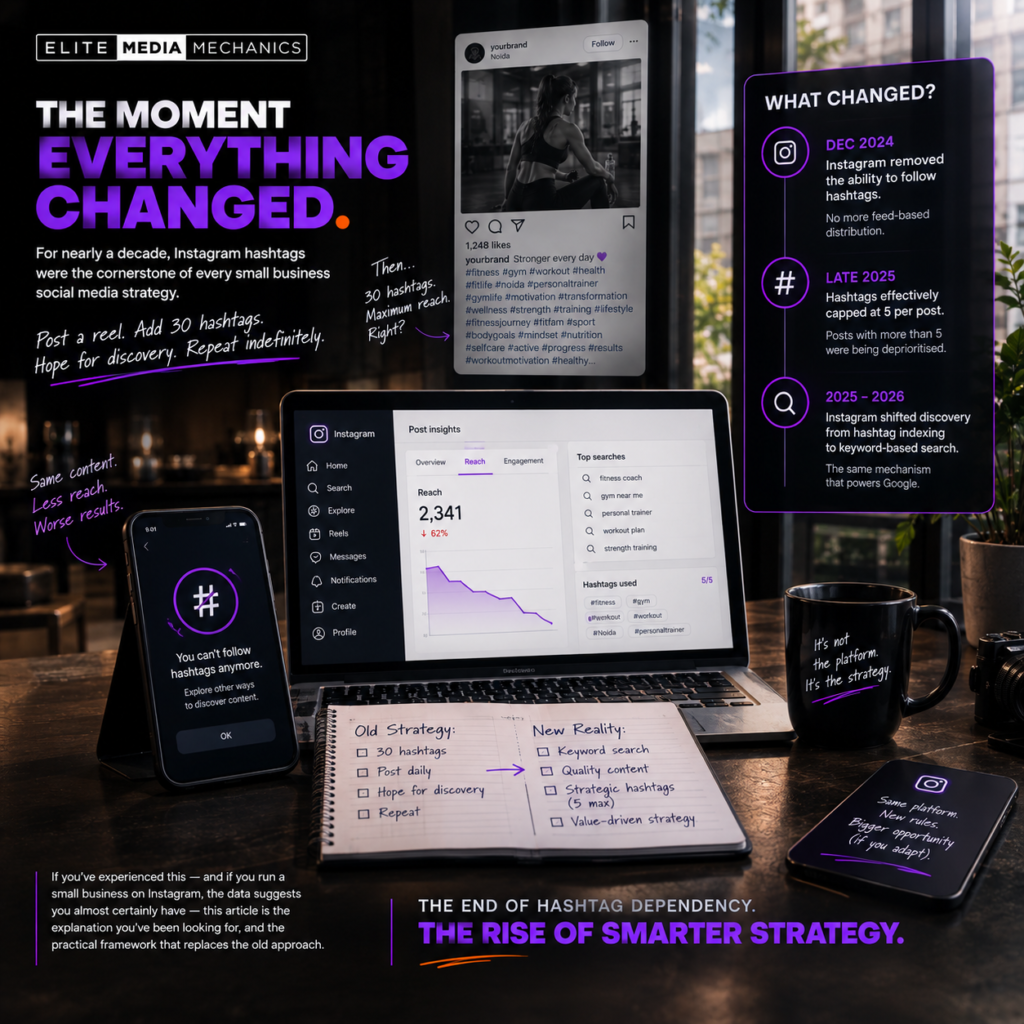
For nearly a decade, Instagram hashtags were the cornerstone of every small business social media strategy. Post a reel. Add 30 hashtags. Hope for discovery. Repeat indefinitely.
Then, quietly and without much fanfare, Instagram dismantled the system.
In December 2024, Instagram removed the ability to follow hashtags — eliminating the feed-based distribution that hashtags had relied upon. In late 2025, the platform effectively capped hashtags at five per post, with internal data suggesting that posts using more than five were being actively deprioritised. And throughout 2025 and into 2026, Instagram shifted its discovery algorithm away from hashtag indexing toward keyword-based content search — the same mechanism that has powered Google for two decades.
For millions of businesses that had built their entire Instagram strategy around hashtag volume, this shift arrived like a power cut. Reach dropped. Discovery slowed. Posting the same content that had worked for years started producing noticeably worse results.
If you’ve experienced this — and if you run a small business on Instagram, the data suggests you almost certainly have — this article is the explanation you’ve been looking for, and the practical framework that replaces the old approach.
Instagram Is Now a Search Engine. Treat It Like One.
Here is the most important thing to understand about Instagram in 2026: it is no longer primarily a social network that distributes content through social connections and hashtag follows. It is increasingly a search engine that surfaces content through keyword relevance and engagement quality.
This is not an exaggeration. According to multiple platform research reports, 64% of Gen Z now uses TikTok and Instagram as their primary search engine — not Google. When a 22-year-old wants to find the best café for studying in their city, they don’t open Google. They search Instagram. When a fitness enthusiast wants to find a personal trainer who specialises in mobility, they search Instagram. When a traveller wants to discover boutique hotels with a specific aesthetic, they search Instagram.
And here’s what makes this even more significant for your business: since July 2025, public Instagram posts have been indexed by Google and Bing. This means your Instagram captions are now being read not just by Instagram’s own algorithm, but by the world’s largest search engines. A well-written, keyword-rich Instagram caption can now appear in Google search results — driving traffic to your profile from people who never opened Instagram at all.
The businesses that understand this are now treating their Instagram captions with the same care that good websites treat their page copy. And the results are showing.
What Instagram Actually Rewards Now
Before we get into the practical framework, it helps to understand what the current Instagram algorithm is actually measuring — because the signals that matter in 2026 are quite different from those that mattered in 2022.
Caption keywords: Instagram now indexes the specific words in your captions to match content to search queries. If someone searches “personal trainer for beginners London,” Instagram surfaces posts whose captions contain those specific terms — not posts with a #PersonalTrainer hashtag.
Saves: When someone saves your post, it signals to Instagram that the content was valuable enough to return to. Saves are now one of the strongest positive signals for distribution, significantly more powerful than likes.
DM shares: When someone sends your post to a friend via DM, Instagram interprets this as the highest possible endorsement — content worth actively recommending to another person. DM shares are now weighted 3–5 times higher than likes in the algorithm’s distribution decisions.
Comments with substance: Generic comments (“nice post,” emoji strings) are now largely ignored by the algorithm. Comments that contain actual words — responses to a question, substantive reactions, disagreements — carry significantly more algorithmic weight.
Watch time and scroll stops: For reels specifically, the algorithm prioritises content that holds attention past the 3-second mark, and rewards content where viewers watch to completion or rewatch. A reel that stops the scroll and holds attention for 15 seconds outperforms a reel that gets 1,000 quick likes.
Profile visits from content: When someone taps your post to visit your profile, this signals that the content generated enough interest to make someone want to know more. This conversion from content to profile visit is a strong indicator of true interest and drives preferential distribution.
The New Instagram Discovery Framework: Caption SEO
If hashtags are no longer the primary discovery mechanism, what replaces them? The answer is caption keyword strategy — and it’s simultaneously simpler and more demanding than the old hashtag approach.
Step 1: Identify your target search terms
Think about what your ideal customer would search on Instagram to find a business like yours. Not what you would call your business — what they would search for.
A gym in Manchester might discover that their audience searches “strength training Manchester,” “gym for beginners near me,” and “women’s fitness classes Manchester” — not just “gym” or “fitness.”
A café in Bangalore might find that searches like “café for working Bangalore,” “quiet café with good WiFi,” and “aesthetic café Koramangala” are what their target customer is actually typing into the Instagram search bar.
A personal trainer in the US might find searches like “online personal trainer for busy professionals,” “strength coach for women over 40,” and “no gym home workout programme.”
These are the specific phrases that need to appear naturally in your captions — not as keywords bolted onto the end, but woven into content that’s genuinely addressing the topic those search terms represent.
Step 2: Write captions that lead with value, not with the hook
The old Instagram caption formula was: hook in the first line, content, call to action, hashtags. The new formula is: hook in the first line, keyword-rich educational or valuable content, call to action, and a maximum of five strategically chosen hashtags at the end.
The key difference is in the middle section. Instead of a brief caption padded with hashtags, your caption should now be substantive enough that it could stand alone as a piece of content — because it is now being indexed as one.
A personal trainer’s caption in 2026 might be 200–400 words explaining a specific training concept, addressing a common mistake, or breaking down a result a client achieved. A café’s caption might describe their coffee sourcing, their environment, and what kind of customer typically works from there. A hotel’s caption might tell the story of the property’s history, the design philosophy, or what a guest’s morning at the property typically looks and feels like.
This level of depth in captions serves three purposes simultaneously: it satisfies the algorithm’s preference for meaningful content, it provides the keyword-rich text that Instagram and Google can index for search, and it gives the reader a reason to save, share, and engage substantively.
Step 3: Use your five hashtags strategically
Since hashtags still carry some discovery value — particularly in niche communities — don’t abandon them entirely. But use them strategically rather than as a volume game.
Choose hashtags that are specific enough to have engaged, relevant communities rather than so broad that your content is immediately buried. A yoga studio using #yoga (over 90 million posts) achieves essentially nothing. The same studio using #YogaForBeginners, #MorningYogaRoutine, and #YogaLondon (if location-specific) has a meaningful chance of discovery within an engaged, relevant audience.
Your five hashtags should be: one broad category tag (your industry or content type), two mid-range relevance tags (more specific to your content), one location tag (your city or neighbourhood), and one branded tag (your own business or campaign hashtag).
Step 4: Optimise your profile as a search landing page
When your content drives a profile visit, what the visitor sees in the next five seconds determines whether they follow you. Your Instagram bio is now a search-indexed landing page — and it should be written accordingly.
Your bio should clearly state: what you do, who you serve, where you operate, and what someone gets from following you. It should contain the primary keywords your target audience would search. “Fitness coach · Strength training for beginners · DM for coaching · London” does more search and conversion work than “Helping you become the best version of yourself.”
Why This Matters More for Local Businesses Than for Anyone Else
The Instagram SEO shift affects all content creators, but it matters most for local businesses — and here’s why.
When a large national or international brand does Instagram SEO, they’re competing in broad keyword categories against thousands of other brands. When a local gym, café, restaurant, or hotel does Instagram SEO, they’re often competing in a much narrower geographic and category space where getting the keywords right produces near-immediate visibility.
A café in Mysore that uses keywords like “café Mysore,” “working café Mysore,” and “aesthetic café in Karnataka” in their captions is now genuinely discoverable by anyone in the region searching Instagram for exactly that. The barrier to ranking for a local search term on Instagram is dramatically lower than the barrier to ranking on Google for the same term.
This is the opportunity that most local businesses are currently missing entirely — because they’re still focused on hashtag volume rather than keyword relevance.
The Compounding Benefit: Instagram × Google × AI Search
Here’s where this becomes genuinely exciting from a strategy perspective.
When you write keyword-rich, substantive Instagram captions and publish them on a public account, three things happen simultaneously in 2026:
On Instagram: Your content surfaces in Instagram’s keyword-based search for the terms you’ve used, increasing your discoverability to new audiences actively searching for what you offer.
On Google/Bing: Since July 2025, those same posts are indexed by Google and Bing. Someone searching Google for “best yoga studio in [city]” may now see your Instagram posts in the results — before they see your website, before they see your Google Business Profile.
On AI platforms: AI search tools like ChatGPT and Perplexity increasingly pull from indexed social media content when constructing recommendations. Instagram posts that are well-written, keyword-relevant, and frequently engaged with are becoming citable sources for AI recommendations — adding a third discovery surface for the same content.
In other words, a single well-written Instagram caption now has the potential to drive discovery across three separate search environments simultaneously. That’s an entirely new level of leverage from a single piece of content — and it’s only available to businesses that understand how the indexing works.
What to Start Doing Differently This Week
You don’t need to rebuild your entire Instagram presence from scratch. You need to change how you write captions — starting with your next post.
Before you publish anything, ask yourself: “What would my ideal customer search to find this content?” Then make sure the answer to that question appears naturally in your caption, ideally in the first two lines.
Audit your last 10 posts. Replace generic captions with substantive, keyword-rich ones. Update your bio to include the primary terms your audience would search. Reduce your hashtags to five, chosen with the specificity criteria above.
Then watch your profile insights over the next 30 days. You’ll typically see an increase in profile visits from non-followers, an increase in reach from accounts that don’t follow you, and — over time — an improvement in follower quality as the algorithm routes your content to people who are genuinely searching for what you offer.
Frequently Asked Questions
Are hashtags completely dead on Instagram in 2026? Not completely — but they’ve been fundamentally demoted. They no longer drive the kind of discovery they once did, and using more than five has been shown to have no positive effect and possible negative effects. Five well-chosen hashtags still serve a purpose. Thirty generic ones no longer do anything useful.
How many words should an Instagram caption be in 2026? There’s no perfect answer, but captions of 150–400 words consistently outperform shorter captions on the metrics that matter most — saves, shares, and substantive comments. The caveat is that the first 125 characters (before the “more” cutoff on mobile) need to be compelling enough to make someone expand the caption. Lead with the hook, deliver value in the body.
Does this apply to Reels as well as regular posts? Yes — caption keywords apply to all post formats including Reels. For Reels specifically, on-screen text also contributes to searchability, because Instagram’s AI can now read text that appears on screen within video content and use it as a relevance signal.
How long before keyword-optimised captions show results? Most accounts see measurable changes in reach from non-followers within 3–6 weeks of consistently applying keyword-rich captions. The compounding effect — as your content accumulates search relevance signals — builds over 3–6 months.
Does my Instagram account need to be public for this to work? Yes. Google, Bing, and Instagram’s own search index only include public accounts. If your business account is set to private for any reason, switch it to public immediately — there’s no legitimate reason for a business account to be private.
How does Instagram SEO differ from Google SEO? The underlying principle is the same — keyword relevance matched to search intent — but the application differs. On Google, you optimise web page content and technical structure. On Instagram, you optimise caption text, bio copy, profile structure, and on-screen text in videos. The authority signals also differ: Instagram prioritises engagement quality (saves, shares, comments) while Google prioritises backlinks and domain authority.
How Elite Media Mechanics Builds Instagram-Searchable Content
We build social media content systems that are designed not just to look good — but to be found. Every caption we create for clients is written with both the human reader and the search algorithm in mind: keyword-relevant, substantive, genuinely valuable, and structured to drive the saves and shares that the algorithm rewards most.
For businesses across the UK, US, and India, we combine Instagram SEO with our broader digital strategy to ensure that every piece of content contributes to discovery across Instagram, Google, and AI search simultaneously.
Pause the problem. Play the solution.
Elite Media Mechanics is a full-service Digital Marketing & PR agency working with fitness, hospitality, and lifestyle brands across the UK, US, and India. We don’t do generic. We fix brands.
Keywords: Instagram SEO 2026, Instagram hashtags dead, Instagram caption strategy, social media search engine, Instagram algorithm 2026, get found on Instagram, local business Instagram, Elite Media Mechanics
© 2026 Elite Media Mechanics. All rights reserved.