
By Elite Media Mechanics | Digital Marketing & PR Agency | UK · US · India
“You don’t own your reputation. Your customers do. But you get to choose what you do with it.”
The Review That Changed Everything
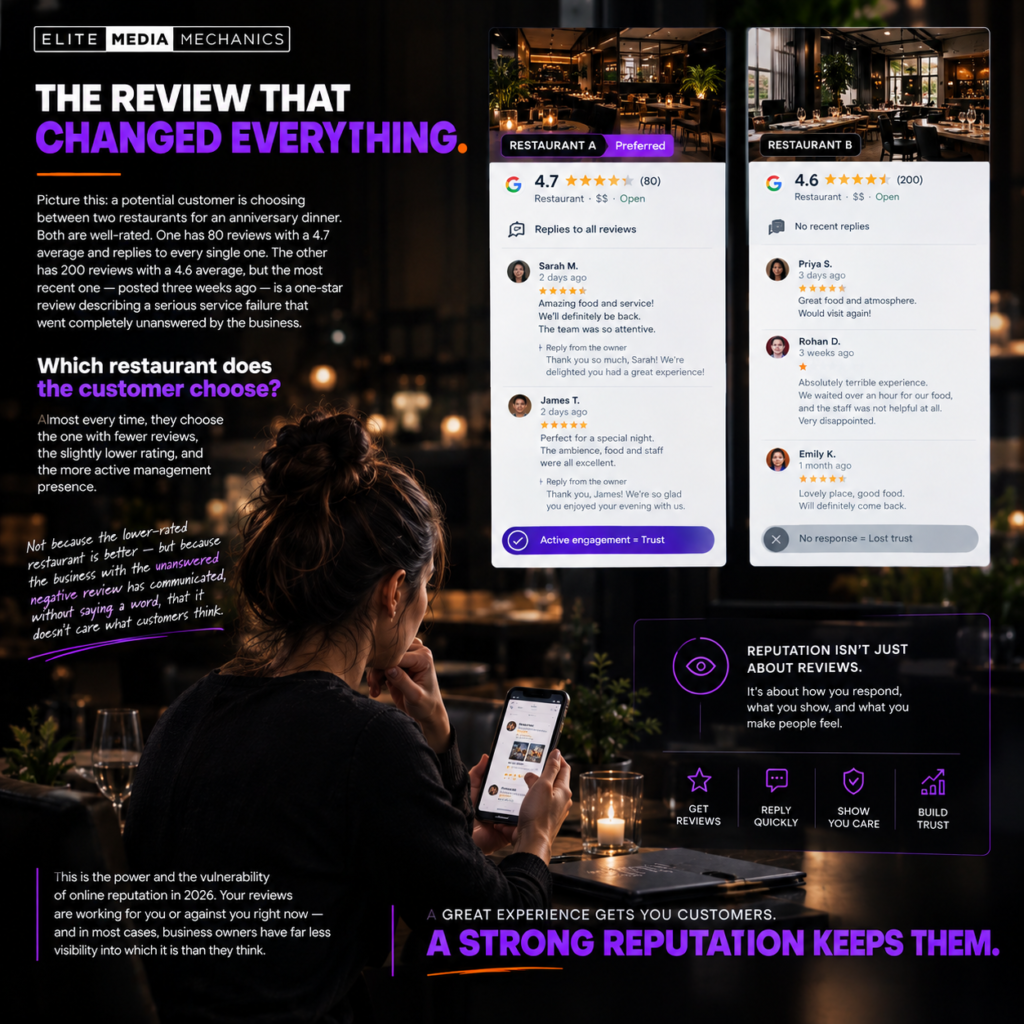
Picture this: a potential customer is choosing between two restaurants for an anniversary dinner. Both are well-rated. One has 80 reviews with a 4.7 average and replies to every single one. The other has 200 reviews with a 4.6 average, but the most recent one — posted three weeks ago — is a one-star review describing a serious service failure that went completely unanswered by the business.
Which restaurant does the customer choose?
Almost every time, they choose the one with fewer reviews, the slightly lower rating, and the more active management presence. Not because the lower-rated restaurant is better — but because the business with the unanswered negative review has communicated, without saying a word, that it doesn’t care what customers think.
This is the power and the vulnerability of online reputation in 2026. Your reviews are working for you or against you right now — and in most cases, business owners have far less visibility into which it is than they think.
The Numbers Behind the Reputation Problem
Before we discuss the strategy for managing online reputation, it helps to understand the full financial reality of what’s at stake. Because most businesses significantly underestimate the impact of reviews on their revenue.
88% of consumers trust online reviews as much as a personal recommendation from a friend. This statistic, which has held broadly consistent for several years, means that a stranger’s Google review carries the same weight as a recommendation from someone your potential customer already knows and trusts. That’s an extraordinary level of influence for something most businesses barely monitor.
97% of consumers read reviews before choosing a local business. Not some consumers. Not most. Essentially all of them. Reviews are no longer an optional part of the decision process — they are a mandatory input for nearly every customer making a decision about where to spend money locally.
One unaddressed negative review can drive away 30 out of 50 potential customers. That’s a 60% loss rate from a single piece of public feedback left unanswered. For a restaurant doing 50 covers a night, one unanswered bad review could be costing them 30 potential bookings per night — not from the customers who had the bad experience, but from the ones who read about it and decided not to take the risk.
73% of consumers only trust reviews written in the last month. This is perhaps the most overlooked statistic in reputation management. A business with 500 reviews collected over five years, where the most recent was eight months ago, carries less consumer trust than a competitor with 30 reviews written in the last 30 days. Review recency signals ongoing quality — that what was true when those reviews were written is still true today.
And perhaps most importantly for 2026: reviews are now one of the primary signals that AI search platforms use to evaluate and recommend local businesses. ChatGPT, Google AI Overviews, and Perplexity all factor review volume, recency, and quality into their recommendation decisions. A business with stale, unanswered, or thin reviews is not just losing consumer trust — it’s losing AI visibility.
The Three Layers of Online Reputation
Understanding reputation management properly means understanding that “reputation” in a digital context isn’t a single thing. It operates across three distinct layers, each of which requires its own strategy.
Layer 1: Review Volume and Recency
How many reviews you have, and how recently they’ve been written, are the two most influential factors in how both potential customers and AI systems evaluate your business.
Volume matters because it represents statistical confidence — a business with 100 reviews is seen as more established and reliable than one with 10, even if the average rating is similar. But recency matters more than most businesses realise, because it signals current operational quality. A high volume of old reviews tells customers that your business used to be good. A steady flow of fresh reviews tells them your business is good right now.
The implication is clear: review generation isn’t a one-time project. It’s an ongoing system that needs to be built into how your business operates every day — not triggered only after a bad review appears.
Layer 2: Your Response Rate and Quality
How you respond to reviews — both positive and negative — tells potential customers more about your business than the reviews themselves in many cases.
Responding to positive reviews warmly and specifically (not with the same copy-pasted “thank you for your feedback” reply every time) signals that real people are behind the business, that they care about customers, and that the experience is consistently good enough to produce repeat positive reactions.
Responding to negative reviews professionally, specifically, and without defensiveness signals something even more important: that your business takes quality seriously, that it acknowledges when things go wrong, and that it’s the kind of organisation customers can trust even when it makes mistakes.
A business that responds to both positive and negative reviews consistently is telling every potential customer who reads those responses: we are a professional operation that takes our reputation seriously. That message is worth more than any amount of marketing.
Layer 3: Your Rating Average
Your star rating is the most immediately visible reputation signal — it appears in search results, in maps, in business listings, and now in AI-generated recommendations. But it’s also the layer that businesses have the least direct control over, and the one where many businesses make the most strategic errors.
The temptation when you have a low average rating is to focus on the rating itself — to try to get it removed, to ask Google to delete negative reviews, to dispute every unfavourable post. This is almost always the wrong approach. The correct approach is to improve the underlying operations that are generating negative reviews, and to build a consistent positive review pipeline that naturally improves the average over time.
A business with a 3.8 rating that is actively improving and generating fresh positive reviews will outperform a business with a 4.2 rating that achieved that number three years ago and hasn’t received a new review since. The trajectory matters as much as the number.
The Four-Step Review Response Framework
How you respond to negative reviews is one of the most influential things you can do for your online reputation — and one of the most commonly done badly. Here is a simple framework that works:
Step 1: Acknowledge without admitting fault or being defensive Begin by recognising that the customer had a poor experience, without immediately either accepting full blame or defending your business against the criticism. “Thank you for sharing this — I’m sorry your experience wasn’t what it should have been” is a far better opening than “We take all feedback seriously” (generic and distancing) or “Our records show that…” (defensive and off-putting).
Step 2: Be specific about the situation if you can If the review mentions a specific incident, dish, staff member, or visit time — acknowledge those specifics. It demonstrates that you’re reading reviews carefully rather than deploying a one-size-fits-all response. Generic responses to specific complaints signal that the business isn’t actually engaging with what the customer experienced.
Step 3: Explain what you’re doing about it — briefly Not defensively, not with excuses — but with a brief, honest statement of what you intend to improve. “We’ve spoken to our team about the wait time issue you experienced” or “I’ve asked our kitchen team to review the consistency of that dish” signals accountability and the kind of management engagement that reassures future customers.
Step 4: Invite the customer back or offer a resolution Close by offering a direct line of contact for resolution — “Please reach out to us at [email] so we can make this right” — or an invitation to return, making clear that you’d like the opportunity to deliver a better experience. This moves the conversation off the public forum and signals to readers that you actively work to resolve problems rather than ignoring them.
The entire response should be 3–5 sentences. Not a paragraph of explanation or justification. Concise, specific, professional, and human.
Building a Proactive Review Generation System
The best defence against negative reviews is a steady pipeline of positive ones — and that pipeline doesn’t appear by itself. It requires a system.
The ask-at-the-right-moment rule: Customers are most likely to leave a positive review immediately after a peak positive moment — when they’re leaving a great session, when a meal has just ended, when they’ve just checked out of a wonderful stay, when they’ve just seen a transformation result. That is the moment to ask, not days later via an email that feels like a chase.
The specific ask: “Would you mind leaving us a Google review?” is significantly less effective than “If you’ve found [specific thing] valuable, it would really help us if you left us a Google review — it takes about 60 seconds and makes a real difference.” Specificity in the ask (naming what they liked, explaining why it matters) produces dramatically higher follow-through.
The frictionless ask: Provide a direct link to your Google review form — not a link to your Google Business Profile that requires the customer to figure out how to leave a review. Every additional step between the ask and the action reduces completion rates significantly. A QR code on a receipt, a link in an email, a direct message link — remove every possible friction.
The consistency rule: Review generation is not a campaign you run once. It’s a practice you embed. Every customer who has a positive experience should encounter a review ask as a natural part of their exit journey — not randomly, not only when you remember, but consistently, as a system.
We built a review generation system for a homeopathy brand in India using these exact principles. The result was 100+ verified Google reviews generated in a structured, consistent way — transforming their local search visibility and giving their Google Business Profile the fresh review signal that AI platforms now prioritise in recommendations.
What to Do When You Have a Genuinely Bad Review
Sometimes the review is accurate. A customer did have a bad experience. The food was inconsistent. The service was slow. The room wasn’t clean. The session was poorly managed.
The worst thing you can do is dispute the review, become defensive, or ignore it. The second worst thing is to apologise generically and do nothing differently.
The correct approach — both for managing the specific customer relationship and for the long-term signal this sends to the hundreds of people who will read your response — is radical honesty combined with specific corrective action.
“You’re right, and I apologise. This isn’t the standard we hold ourselves to, and the specific issue you’ve described has been addressed directly with our team. I’d genuinely like the opportunity to give you a different experience. Please get in touch at [email].”
This kind of response does something remarkable: it turns a potential reputation crisis into a credibility signal. Potential customers reading this response see a business that acknowledges mistakes, takes them seriously, and holds itself to a standard. That’s far more trust-building than a page full of generic five-star reviews with no management responses.
Reputation Management in the AI Search Era
Here is the emerging dimension of reputation management that most businesses haven’t caught up to yet.
AI search platforms — ChatGPT, Perplexity, Google AI Overviews — now factor review quality into their recommendations for local businesses. When an AI system is asked to recommend a restaurant in [city], it evaluates:
- Review volume (how many reviews exist)
- Review recency (how recently they were written)
- Review detail (how specifically customers describe their experience)
- Response rate (whether the business responds to reviews)
- Average rating (the overall score)
- Sentiment consistency (whether positive reviews are consistently about the same strengths)
A business with 15 detailed, recent reviews and 100% response rate will often receive better AI recommendations than a business with 200 old reviews and no responses — because the AI interprets the active management and fresh signals as evidence of current operational quality.
This makes reputation management not just a consumer trust issue in 2026, but a fundamental visibility issue. Neglecting your reviews doesn’t just cost you individual customers. It increasingly costs you the AI discovery that is becoming the primary way new customers find local businesses at all.
Frequently Asked Questions
Can I ask Google to remove a negative review? Google will remove reviews that violate their policies — spam, fake reviews, off-topic content, or content containing prohibited material. However, legitimate negative reviews from real customers experiencing a genuine issue cannot be removed by request. Attempting to game the removal system typically backfires. The better approach is always to respond professionally and build positive review volume.
How should I respond to a fake review from someone who was never my customer? Flag it to Google for policy violation review. In your public response, briefly and calmly note that you have no record of the described experience and invite the reviewer to contact you directly with their visit details — this gives context to future readers without being confrontational or inflammatory.
How many Google reviews should I aim for? There’s no single target, but research consistently shows meaningful trust and visibility improvements once a business passes 20–25 reviews, with continued gains at 50+. More importantly than a total count: aim for a steady stream of fresh reviews (at least 2–4 per month for a small local business) rather than a large but dated total.
Should I respond to positive reviews as well as negative ones? Yes — and not with the same copy-pasted response every time. Specific, warm responses to positive reviews signal to future readers that real people care about the business and its customers. It also often encourages the reviewer to return, because being acknowledged makes people feel valued.
Does responding to reviews help with Google rankings? Review responses are a positive signal within Google’s local ranking algorithm. More directly, actively managed review profiles (responses, fresh reviews, complete information) perform better in both traditional Google search and in AI-generated recommendations than neglected profiles.
How do I ask for a review without feeling pushy? Frame it as feedback rather than a favour: “Your experience really matters to us — if you have a moment, we’d love to hear what you thought on Google.” Delivered at the right moment (the peak of a positive experience) and with a direct, frictionless link, this rarely feels pushy. What feels pushy is repeated follow-up emails weeks after the experience.
How Elite Media Mechanics Manages Reputation
We build review generation systems and reputation management strategies for healthcare brands, restaurants, hotels, gyms, and other experience-led businesses across the UK, US, and India — including the structured patient review system that generated 100+ verified reviews for a healthcare brand in India.
Our reputation management work is proactive, systematic, and connected to your broader digital strategy — because your reviews aren’t just a trust signal for customers. In 2026, they’re a fundamental component of your AI search visibility.
Pause the problem. Play the solution.
Elite Media Mechanics is a full-service Digital Marketing & PR agency working with fitness, hospitality, and lifestyle brands across the UK, US, and India. We don’t do generic. We fix brands.
Keywords: online reputation management 2026, negative review response, Google review strategy, local business reputation, ORM small business UK India, how to get more Google reviews, reputation management hospitality, Elite Media Mechanics
© 2026 Elite Media Mechanics. All rights reserved.