By Elite Media Mechanics | Digital Marketing & PR Agency | UK · US · India
“The playbook that worked in 2023 isn’t just outdated in 2026 — for some businesses, it’s actively working against them.”
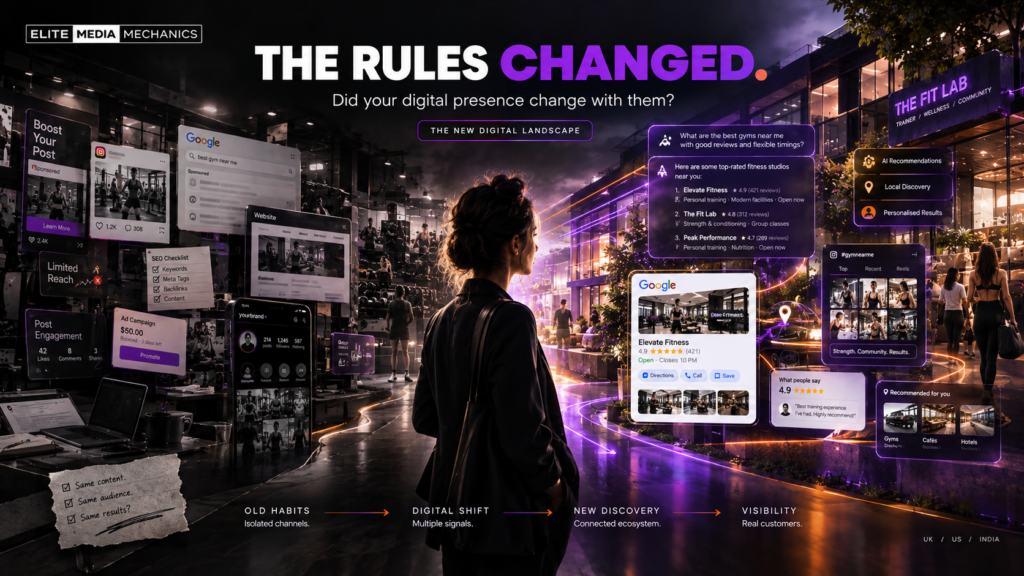
The Marketing Landscape Has Quietly Changed — And Most Businesses Haven’t Noticed
If you’re a gym owner, café founder, hotelier, or personal trainer still marketing the way you did two years ago, here’s the uncomfortable reality: the rules changed underneath you, and nobody sent a memo.
Search engines don’t just show links anymore — they generate answers. Customers don’t just scroll Instagram — they ask AI assistants for recommendations. And the businesses that haven’t adapted are becoming invisible, even while doing everything that “used to work.”
We’ve audited dozens of business digital presences across the UK, US, and India. The same five mistakes appear, almost without exception, regardless of industry, market, or budget level. And in most cases, the business owner has no idea they’re making them — because on the surface, everything looks like it’s working.
Here are the five most damaging digital marketing mistakes local businesses are making right now — with the exact fix for each.
Mistake #1: Treating Google Business Profile as an Afterthought
This is, by a wide margin, the single biggest blind spot we see in 2026.
Most local businesses set up their Google Business Profile once — years ago — and never touch it again. No new photos. No posts. No responses to reviews. No updated hours when they change. Just a static, half-finished listing sitting there, quietly losing them customers every single day.
Here’s why that matters more now than it ever has before: your Google Business Profile is no longer just a directory listing. It has become the primary data source that AI search platforms use to evaluate, understand, and recommend your business.
When someone asks Google’s AI Overview “best personal trainer in [city]” or asks ChatGPT “good family restaurant near [location],” the AI isn’t reading your website first. It’s reading your Business Profile. It’s evaluating your review volume, your recency, your photo freshness, your category accuracy, and your Q&A responses. If that profile is incomplete, stale, or inconsistent — the AI either can’t recommend you, or actively deprioritises you in favour of a competitor whose profile is properly maintained.
The numbers tell the same story: a complete Google Business Profile generates up to 7 times more clicks, and customers are 2.7 times more likely to trust a business with a fully completed profile. An incomplete profile doesn’t just rank lower — it makes you functionally invisible to the tools more and more people are using to discover where to go and who to hire.
The Fix: Treat your Google Business Profile like a living page, not a one-time form. Update your hours whenever they change. Add fresh photos at least weekly. Post offers, updates, or events monthly. Respond to every review — good or bad — within 48 hours. Answer questions in the Q&A section proactively, before customers have to ask them. This single fix alone often produces faster results than an entire ad campaign — because you’re not fighting for visibility, you’re simply removing the barriers stopping it.
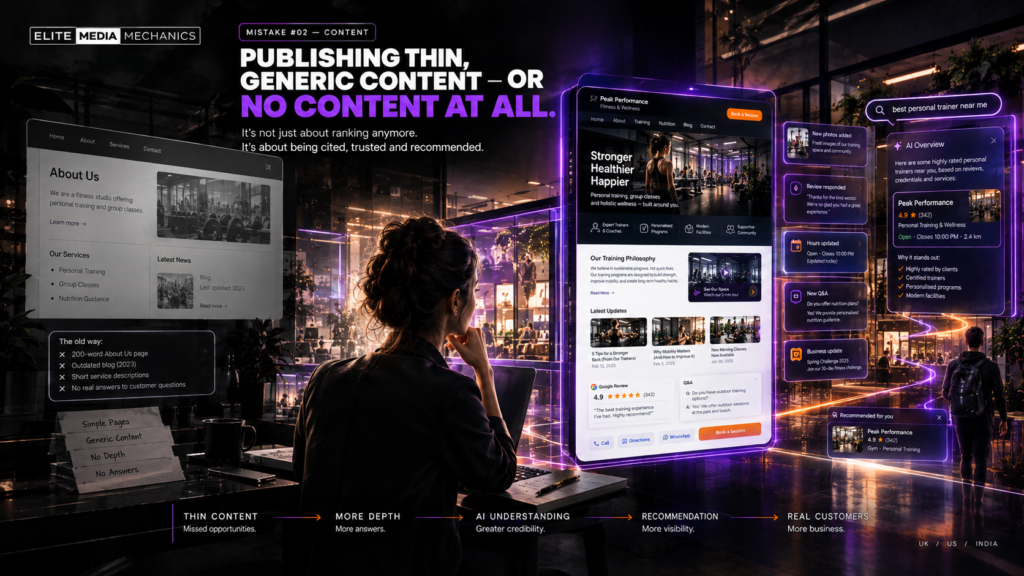
Mistake #2: Publishing Thin, Generic Content — Or No Content At All
A 200-word “About Us” page. A blog that hasn’t been updated since 2023. Service pages with a single paragraph and three bullet points. A website that tells visitors what you do but never answers a single question they might actually have.
This used to be acceptable. It no longer is — and the reason is more fundamental than most businesses realise.
Google’s Helpful Content systems now actively suppress thin, low-value pages. Content under roughly 500 words rarely ranks for any competitive local keyword in 2026. But there’s an even bigger problem than Google rankings.
AI search platforms — Google AI Overviews, ChatGPT, Perplexity — don’t just index websites. They read them. They extract answers from them. They evaluate whether a website’s content is authoritative enough to cite in their generated responses.
If your content is thin, your business becomes uncitable. And uncitable businesses don’t appear in AI-generated answers — even if they’re ranking on page one of traditional search results. This is how businesses with strong traditional SEO are suddenly losing visibility: they rank, but they’re not being cited, because their content doesn’t give AI tools enough to work with.
AI Overviews now appear in roughly 44% of all search queries — meaning nearly half the time someone searches for “best gym near me” or “boutique hotel with breakfast included,” they may never even see a traditional list of links. They see an AI-generated answer instead.
The Fix: Every core page on your website needs genuine depth. Not filler. Real answers to real questions your customers are asking. For a gym, that means explaining your training philosophy, your community, your results, and what a new member can expect in their first 30 days. For a restaurant, it means describing your ingredients, your sourcing, your story, and what makes your dishes different from the restaurant two streets away. Aim for a minimum of 500 words on every service or product page, and 1,500–2,500 words on every blog post. Make it detailed enough that someone could read it and genuinely understand your business — because AI systems are doing exactly that before they decide whether to recommend you.
Mistake #3: Pouring Money Into Ads While Organic Presence Sits at Zero
This is one of the most expensive mistakes a small business can make — and one of the most common.
Many business owners are convinced (often by agencies with a financial incentive to run ads) to spend heavily on paid advertising, while their organic search presence generates close to nothing. The result is a business that’s essentially renting visibility every single month, with nothing being built underneath it. The moment the ad spend stops, the visibility disappears completely.
Here’s the strategic problem with that model: organic search still drives more than 53% of all website traffic — more than paid search, more than social, more than email, more than any other single channel. That means businesses neglecting organic growth are ignoring the channel that accounts for the majority of how customers actually find them online.
Paid ads have their place — they’re excellent for launching new offers, testing messaging, and driving short-term enquiries. But they work best when they’re amplifying an organic foundation that’s already building trust. When they replace that foundation entirely, you get a business that’s permanently dependent on ad spend just to stay visible — with no compounding returns, no growing authority, and no resilience.
We consistently see businesses spending £1,000–£3,000 per month on ads with minimal tracking, while spending nothing on the SEO, content, and Google Business Profile optimisation that would generate sustainable organic traffic without that ongoing cost.
The Fix: Ads should support an organic foundation — not replace it. Build your SEO, your content strategy, and your Google Business Profile to a strong baseline before or alongside any paid activity. A minimum viable organic strategy in 2026 includes: a complete, actively managed Google Business Profile; regular blog content addressing the specific questions your customers search for; properly structured service pages with real depth; and consistent review generation. Once that foundation is in place, paid ads become a multiplier — not a lifeline.
Mistake #4: Inconsistent Business Information Across the Internet
This sounds minor. It is not.
Your business name, address, and phone number need to match — exactly — across your website, Google Business Profile, Instagram, Facebook, Yelp, TripAdvisor, Justdial, and every other directory or platform you appear on. A missing apartment number here. An old phone number there. A slightly different business name on one platform. These small inconsistencies create a surprisingly large problem.
Search engines and AI platforms use the consistency of your business information as a trust signal. When the same name, address, and phone number appear consistently across the web, it signals that your business is legitimate and established. When they don’t match — even in small ways — the algorithm interprets it as unreliability, which damages your local search rankings and your ability to appear in AI-generated recommendations.
The consumer impact is even more direct: 62% of consumers say they would avoid a business entirely if they found incorrect information about it online. That’s not a ranking penalty — that’s a customer who was ready to choose you, found a conflicting phone number or address, and chose not to take the risk.
We regularly find businesses with different trading names across platforms (e.g., “The Blue Door Café” on Google vs “Blue Door Cafe” on Facebook vs “The Blue Door” on Instagram), outdated phone numbers from a previous location, and old website URLs still listed on third-party directories. Each inconsistency is invisible to the business owner and damaging to any customer who encounters it.
The Fix: Audit every platform your business appears on — Google Business Profile, Apple Maps, Bing Places, Facebook, Instagram, LinkedIn, TripAdvisor, Yelp, Justdial (for India), and any industry-specific directories. Standardise your business name, address, phone number, website URL, and business description across every one. Use exactly the same format every time — including whether you abbreviate “Street” or “St,” whether you include a comma before your postcode, and whether your business name includes “The” or not. It’s unglamorous work. It is also one of the highest-leverage fixes available to any local business.
Mistake #5: Ignoring AI Search Entirely
This is the newest mistake on the list — and the one almost nobody has fixed yet.
In 2026, an estimated 92% of brands remain completely invisible to ChatGPT and other AI search platforms, while AI-driven search traffic has grown by over 500% year-over-year. Meanwhile, 45% of consumers now use AI tools for local business recommendations — up from just 6% a year earlier.
Here’s what most business owners don’t realise: AI search doesn’t work like traditional SEO. It doesn’t look primarily at keywords — it looks for structured, clear, trustworthy content it can confidently cite as an answer. It evaluates your review quality, your content depth, your business information consistency, and your overall digital authority.
And crucially, it evaluates whether your content actually answers the questions people are asking. An AI platform asked “best yoga studio for beginners in [city]” isn’t scanning for the phrase “yoga studio beginners” in your H1 tag. It’s looking for content that genuinely explains your beginner-friendly approach, your class structure, your instructors’ experience, and what a first-time student can expect. If that content doesn’t exist on your website, you don’t get cited.
Traditional SEO helped you rank for what people typed. AI search rewards you for answering what people mean. That’s a fundamentally different content challenge — and most businesses haven’t started addressing it.
The Fix: Structure your content so it directly answers the specific questions your customers are asking. “What is the best gym for beginners in [location]?” “Which café in [city] has the best working environment?” “What makes [hotel type] worth the price in [destination]?” Create clear, specific, well-organised content that answers these questions with genuine authority. Use FAQ sections on every key page. Use structured headers. Give concrete examples and real specifics — not vague marketing language. This is what AI search tools reward. Vague brand-speak is what they ignore.
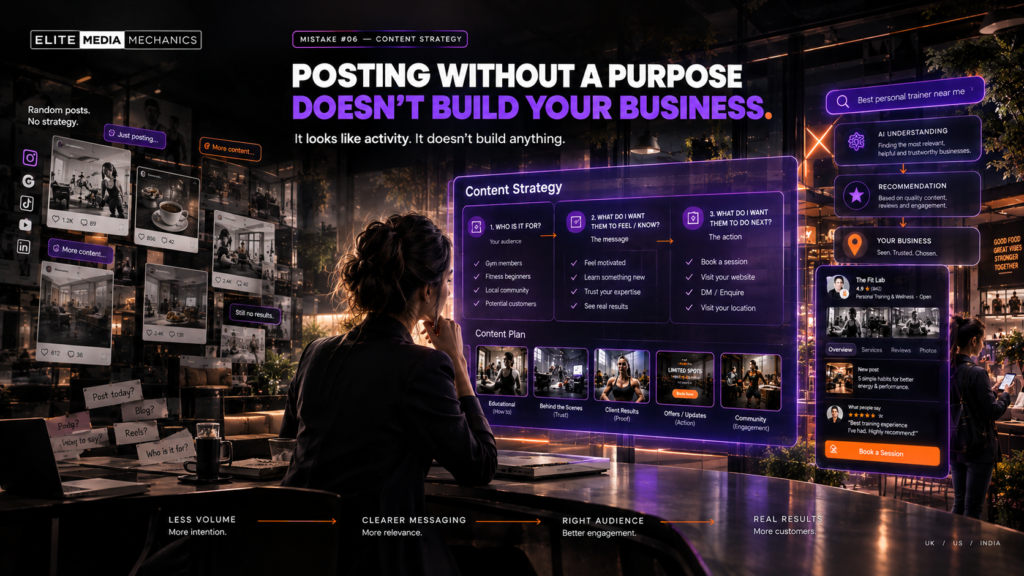
Bonus Mistake: Posting Without a Strategy Behind It
Since we’re being thorough — there’s a sixth mistake that deserves mention, because it’s the underlying cause of why content marketing fails for so many businesses even when they’re doing everything else right.
Posting content — on Instagram, on your blog, on Google Business Profile — without a clear strategic purpose behind each piece is one of the most common and costly wastes of marketing effort we see. It looks like activity. It doesn’t build anything.
Every piece of content your business publishes should have a clear answer to three questions: Who is this for? What do I want them to feel or know? What do I want them to do next? Without those answers, you’re not building a marketing system — you’re filling a calendar.
According to Sprout Social’s Q1 2026 Pulse Survey, 66% of social media users are now more selective about what they engage with than they were a year ago. Audiences are not rewarding volume. They are rewarding relevance and depth. The businesses gaining organic reach and building genuine audiences in 2026 are the ones posting less, more intentionally, with a clear editorial strategy behind every piece.
The Fix: Before you post anything, answer the three questions above. Build a content strategy that maps each piece of content to a specific audience segment, a specific problem that audience has, and a specific action you want them to take. That level of intentionality transforms content from an obligation into a genuine marketing asset.
The Pattern Behind All Five Mistakes
Look closely at these mistakes and they share one root cause: businesses are marketing for the world as it was, not the world as it is.
The map has changed. Search isn’t just blue links anymore — it’s AI answers, local packs, review ecosystems, and structured data working together. Instagram isn’t just a photo platform — it’s a search engine where keywords in captions now drive discovery more than hashtags ever did. A Google Business Profile isn’t a one-time form — it’s a real-time data feed that AI platforms read to decide who to recommend.
A business that masters only one of these channels while ignoring the rest is operating with half a strategy in a moment that demands all of it. But here’s the encouraging reality: most of your competitors are making at least three of these mistakes right now. The businesses that fix them early don’t just improve their marketing — they gain a first-mover advantage in a landscape most businesses haven’t caught up to yet.
Frequently Asked Questions
Which of these five mistakes has the biggest impact on revenue? In our experience, Mistake #1 (Google Business Profile neglect) and Mistake #5 (AI search invisibility) have the most immediate revenue impact — because they affect how many people can find you in the first place. However, Mistake #3 (ads without organic foundation) often represents the biggest financial waste, because it’s an ongoing cost with no compounding return.
How long does it take to fix these mistakes? Mistakes #4 (inconsistent information) and #1 (Google Business Profile) can be corrected within 1–2 weeks. The impact on local search rankings typically follows within 4–8 weeks. Mistakes #2 and #5 (content depth and AI visibility) take longer — typically 3–6 months to build meaningful authority — but have the strongest long-term impact.
Do these mistakes apply to businesses in India as well as the UK and US? Yes — and in some respects more acutely in India, where local search competition is intensifying rapidly. India has the largest Instagram audience in the world (363 million users) and growing AI search adoption. The businesses in India that fix these mistakes now will have a significant advantage over competitors who wait.
Can I fix these mistakes myself, or do I need an agency? Most of these fixes can be started independently — particularly the Google Business Profile optimisation and information consistency audit. The content depth and AI search visibility challenges benefit significantly from professional strategic input, because the technical requirements (schema markup, FAQ structure, topical authority building) are more complex and time-consuming than they appear.
What should I fix first? In order of fastest impact: (1) Update and complete your Google Business Profile. (2) Audit your business information consistency across all platforms. (3) Add depth to your core website pages. (4) Begin a review generation strategy. (5) Start building AI-readable content structures. Each of these builds on the previous one.
How Elite Media Mechanics Fixes This
We built our process specifically for businesses like yours — gyms, personal trainers, cafés, restaurants, hotels, and Airbnb hosts across the UK, US, and India — because generic marketing advice from generic agencies doesn’t work for businesses competing on trust, locality, and experience.
Our Invisible Brand Audit identifies exactly which of these five mistakes is costing you the most — and builds a plan that fixes the foundation first, before a single rupee, pound, or dollar goes toward paid advertising.
Pause the problem. Play the solution.
Ready to See Which Mistakes Are Costing You Customers?
Most businesses are making at least two or three of these mistakes without realising it. The good news — every single one of them is fixable.
Elite Media Mechanics is a full-service Digital Marketing & PR agency working with fitness, hospitality, and lifestyle brands across the UK, US, and India. We don’t do generic. We fix brands.
Keywords: digital marketing mistakes 2026, local SEO mistakes, AI search optimization, Google Business Profile tips, small business marketing UK, gym marketing mistakes, restaurant SEO India, hotel digital marketing strategy, GEO marketing, local business visibility, Elite Media Mechanics